


Custom name tags look professional when people can read them quickly and connect them with the organization. Clear names, balanced branding, suitable materials, clean edges, and secure attachments matter more than decoration.
The best business name tags also fit the job. A design for a hotel receptionist may not suit a warehouse visitor or a one-day conference. Begin with the setting, then decide on information, material, finish, and fastening.
Start With the Job the Tag Must Do
Before designing custom name tags, define the wearer, reader, and expected period of use. This brief prevents attractive artwork from becoming impractical on a uniform.
For customer-facing employee name tags, the preferred name deserves the most space. A short role helps visitors find a manager, technician, server, or sales associate. Reusable name tags fit seasonal teams because the name can change while the branded frame remains.
Security requires a different specification. A photograph, barcode, expiration date, or access level makes the piece one of the organization’s ID badges rather than a simple introduction tool. That distinction affects privacy and replacement control.
For office name tags and event credentials, keep only information that supports recognition, service, access, or conversation.
Make the Name the First Thing People See
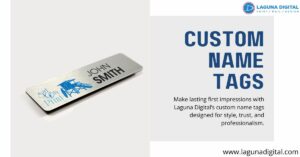
Professional custom name tags use a clear order. Put the person’s name first, add a short role when useful, and keep the logo from taking over the space.
Clean sans-serif lettering suits name badges because open letters remain clear at small sizes. Use one type family, with a semibold name and a smaller regular-weight role.
Design with the longest staff name, not a short placeholder. This reveals narrow margins and awkward breaks before production. It also keeps personalized name tags visually equal.
Dark text on a light surface and light text on a dark surface are reliable starting points. Patterns, photographs, and gradients may work as accents, but the name needs a calm background.
Review custom badges in grayscale. If the name, role, and logo blend together, strengthen the contrast or spacing. This check catches problems a bright monitor can hide.
Match the Material and Finish to the Setting
Material changes the weight, durability, and tone of custom name tags. An event piece has different demands from one worn during every shift, so choose for use rather than appearance alone.
Laguna Digital’s current name-tag printing options list full-color 10 pt., 14 pt., and 16 pt. cardstock with gloss, matte, high-gloss, rounded-corner, and hole-drilling choices. Other materials or fasteners should be confirmed before ordering.
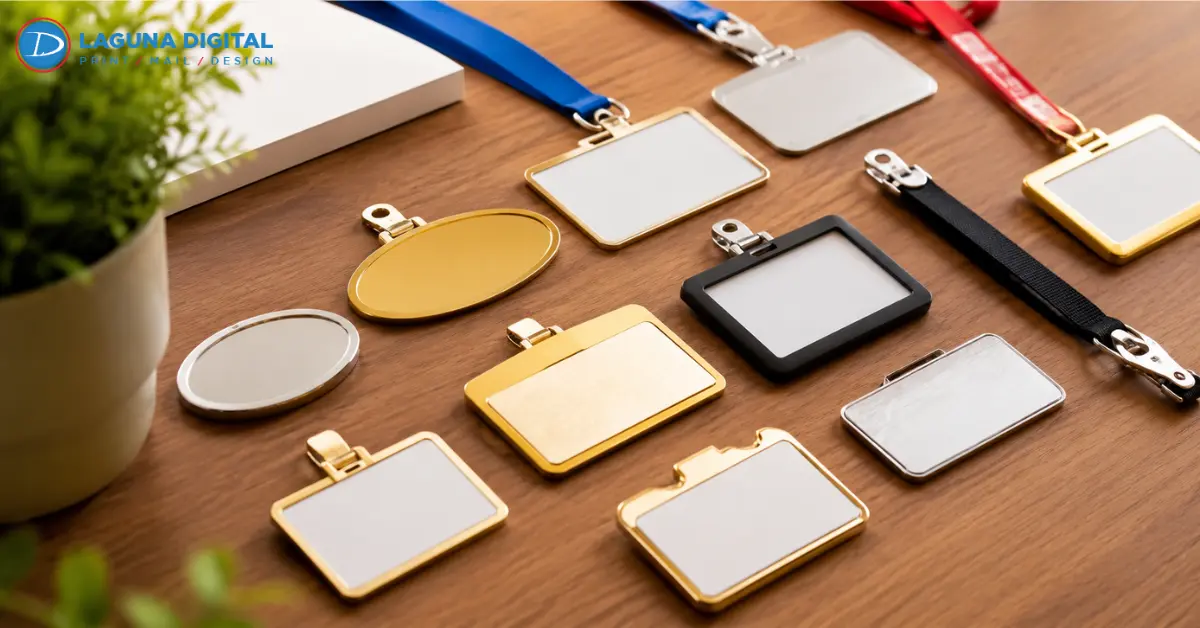
Plastic name tags are lightweight and support full-color graphics. Look for accurate logo reproduction and smooth edges.
Metal name tags can suit hospitality, real estate, executive, and premium retail roles. Test their extra weight on the actual uniform.
Engraved name tags favor permanent lettering and restrained layouts where crisp contrast matters more than complex artwork.
Finish affects visibility. Gloss can brighten color but reflect overhead light. Matte usually shows less glare, while high gloss adds shine. Judge each option under workplace lighting.
Choose an Attachment for the Uniform
A professional appearance depends on whether custom name tags stay level, secure, and comfortable. Test the fastener on each main garment.
Magnetic name tags avoid piercing many fabrics but do not suit every wearer. The FDA warns that strong magnets can affect certain implanted medical devices, so employers should offer another fastener.
Pins are economical but can mark delicate fabric. Clips need a stable edge. Lanyards and badge holders suit larger credentials, but must keep the printed face upright.
Different garments hold attachments differently. Wear each sample while walking, reaching, and sitting. A tag that tilts during normal movement will not look consistent.
Use a Two-Minute Proof Test
Approve custom name tags at actual size. A screen cannot show glare, stiffness, edge quality, attachment balance, or the final clarity of small text.
Use this quick proof sequence:
- Print the design at its finished dimensions.
- Insert the longest name and the longest approved title.
- View it from a normal speaking distance under workplace lighting.
- Compare the logo and colors with current brand references.
- Attach it to every main uniform and move naturally.
- Check spelling, margins, corners, holes, and finish.
Review several employee name tags rather than one ideal example. Test any photos or barcodes. If a protective holder will be used, inspect the complete assembly for cropped edges or glare.
Physical proofs also reveal material problems. Check lightweight samples for smooth edges and heavier ones for balance. Correct any piece that pulls, twists, reflects too much light, or reduces the wearer’s name.
Keep Every Team and Location Consistent
Consistency gives custom name tags credibility. Fix the logo size, margins, capitalization, title style, colors, corners, and attachment. Only approved personal information should change.
For business name tags used across locations, record each name, role, location, material, finish, and backing. Assign one spelling approver and retain the specification for replacements.
Office name tags should match reception signs, uniforms, and current branding. Old logos, different colors, and mixed title styles become obvious when employees stand together.
Keep reusable name tags presentable with matching inserts and one printing method. Replace scratched windows, and store extras according to the manufacturer’s instructions.
Custom badges for visitors need a return or disposal process. Permanent staff identification needs controlled replacement so outdated credentials do not remain in use.
Correct the Details That Lower Credibility
Overfilled custom name tags are difficult to read. A small surface cannot emphasize a logo, full name, title, department, slogan, website, phone number, and QR code. Keep only what supports recognition.
Warning signs include stretched logos, thin letters, weak contrast, rough edges, random capitals, and rotating fasteners. Name badges also need one consistent wearing position.
Do not make ordinary introductions resemble secure ID badges. For access control, define the required photograph, encoded data, expiration details, authorization, and replacement process first.
Check the whole wearing system. Poor badge holders can cover text, reflect light, or bend. Replacement pieces also lose consistency when recreated from screenshots instead of approved artwork.
Frequently Asked Questions
What is the best size for a professional name tag?
The best size holds the name, logo, and role without shrinking text or crowding the margins. Use a larger credential when a photograph, location, or access detail must remain visible.
Are plastic or metal options more professional?
Both can work when matched to the setting. Plastic name tags are lightweight and support detailed color. Metal name tags look more formal but need a stronger fastener.
Are magnetic fasteners better than pins?
Magnetic name tags protect many fabrics, while pins are economical. Consider fabric, movement, holding strength, workplace equipment, and medical safety.
Is printing better than engraving?
Printing supports full-color logos, photographs, and gradients. Engraved name tags provide permanent lettering with a minimal appearance. Choose according to the artwork and expected wear.
What belongs on a personalized staff tag?
Most personalized name tags need a preferred name, logo, and short role. Add a credential, photograph, or access detail only for a clear workplace purpose.
To Sum Up
Professional custom name tags come from connected decisions. Define the job, make the name easy to find, choose the stock and finish, test the attachment, and approve a physical proof.
Prepare an accurate staff list and assign one spelling approver. Review Laguna Digital for professional printing support or contact us to confirm the project specifications. Approve one complete sample before authorizing the full order.