


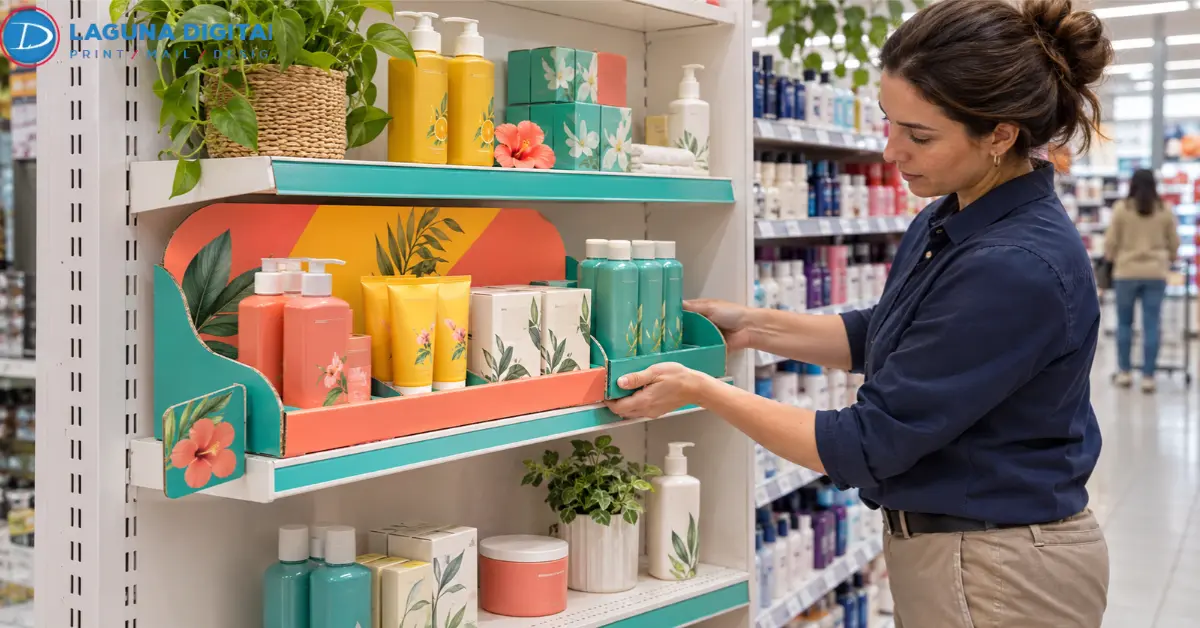
Consider amending shelf display designs if they create issues for customers or stockers. If custom retail displays are required, consider the issues with current displays. If items cannot be easily compared, or space is wasted/stocking is time-consuming, a well-merchandised display will solve these issues. Changes have been made to match visual requirements with functional requirements for daily operations.
Shelf Displays Need A Clearer Selling Role
Product Comparison
Within this display of ground coffee, roast, bag size and price are key considerations for customers. These key selling points should be easy to compare. The message at the bottom of the shelf should be directly below the relevant item. It should not detract from information on the package.
A successful display will mean differences in products within the same category can be easily understood.
Stock Availability
It is unhelpful to have a display if the item is unavailable. Before amending displays, check how much of the item is in stock relative to sales between stock top-ups. For single-deep displays, multiply the number of facings by the number of units deep to give a good idea of total stock capacity. In custom displays, there should be enough of the item in stock to meet expected demand until stock is topped up.
However, large panels and separators can reduce this capacity. When considering a new display layout, ensure that with all products (including the fastest-moving products) loaded into the display fixtures within the store, there is enough stock to meet expectations fully. Do not approve a layout just because it appears full in a proof.
Store Dimensions Decide What Fits
Usable Shelf Space
Be careful with unit sizes. The available area may be reduced by shelf edges, fittings, lighting and pricing.
For example, although there is 48 in of space, with 16 3 in cartons and dividers/clearance may not be possible. Refer to physical samples to confirm what can fit. Ensure there is enough clearance in retail display fixtures to allow customers to pull the desired carton out of place without disturbing others.
If using a free-standing display, check the footprint of the unit with all products in place and ensure that the unit remains stable. The unit should fit within the approved location at all times during regular usage.
Restocking Access
Planograms indicate where products should sit and how many facings. Including product codes and images means staff can easily re-create the display after refilling.
Request build instructions from your retail display supplier and ask a member of staff in store to refill the sample. Within shelf displays, if refills require the header to be removed, or surrounding products to be moved, changes may be required. If issues are found, be sure to note them while it is still easy to make changes.
Printed Messages Need A Clear Hierarchy
Product-Level Information
After the display layout has been decided, design the graphics to reflect the purchasing process. General category information should be clear to people approaching the display. More specific information such as prices and product differences should be nearer to the product.
These displays have been designed for people to read from various distances. In a display of various types of coffee, general category information should be included. However, there should be room for roast type and bag size in relation to each product. To avoid competing for space, do not include the full campaign message on all surfaces.
Campaign Detail
If there is specific information to include (products included, dates and conditions to purchase), include this on printed campaign posters close to the display. Include only item and price information on the bottom of the shelves.
Ensure both displays include the same offer information and versions of artwork. When proofing, ensure wording is consistent and, once printed to full size, view in-store lighting. Even with correct files, unwanted reflections or obscured text may occur due to stocked products.
A Detailed Brief Prevents Reprints
A detailed brief ensures designs in line with approval appear as intended in store. Provide your retail display supplier with agreed exact measurements, versions of artwork, quantities and fitting requirements.
| Brief Element | Detail To Record |
| Store Location | Bay measurements, fixture photographs, and attachment points |
| Printed Graphics | Finished size, board thickness, print finish, and artwork version |
| Delivery | Quantities by location, packing labels, and required arrival date |
| Approval | Named reviewer, approved proof, and retained sample specification |
Weight capacity and spare parts: Ensure these are known. If creating bespoke displays, ensure the display is tried with the products within. A signed proof will confirm design, but not weight capacity when stocked.
Material Choices Affect Daily Upkeep
Cleaning And Handling
Ensure the environment is described in sufficient detail. A temporary display within a dry area will be subject to different handling than those in areas prone to spillage or regular wet cleaning.
To allow flat headers, ensure that the header will be mounted on a sufficiently rigid backing. The thickness and fixings should be appropriate for the location. Check the sample, including edges and fixing holes.
Ensure accessories for retail shelving are compatible with cleaning products and handling within the store. Ask the manufacturer to confirm which parts of the display support product weight.
Replacement Graphics
If the graphic can be changed easily from the base of the display, seasonal changes to the display can be made more easily. If the promotion has expired, hardware should not need to be replaced if it is still in working condition.
Check that displays have easy fixing mechanisms and easy replacement of graphics. For display stands in retail, consider shipping, fitting, and probable repairs in your budget. This may impact whether a cheap option is cost-effective across the planned campaign period.
Performance Requires More Than A Sales Lift
Fair Comparisons
Only make one meaningful change to the display, such as the header, product configuration or added façade.
Where possible, keep pricing and promotional activities consistent. Compare similar stores on the same day of the week and note any out-of-stocks and unusual levels of trading. Increasing sales due to a discount cannot be attributed to improvements in the display. If the number of transactions is low, consider running the test for longer.
Category Profit
When displaying products, take into consideration the stock levels and restocking times. This will help provide context to the visual merchandising review.
If a 4ft bay generates $240 in sales in a week, it creates $60 per linear foot. If $300 in sales are generated, it creates $75 per linear foot. This shows productivity; however, it does not show margin or cost of the campaign.
As a result, when making visual merchandising decisions for retail, you should consider the gross profit for that category, as well as the cost of graphics, hardware, shipping and labour.
It may be that the sales of a product on display reduce sales of the adjacent product. Only expand the test if an overall positive result is achieved to justify the investment.
Frequently Asked Questions
What is the purpose of retail displays?
Products are grouped using various materials, including trays, separators, headers and shelf linings. They should be simple to understand, easy to stock and easy to maintain. This will make them effective.
How can I improve the visibility of products?
Ensure product pricing is correct, product information is not obscuring the product itself, and related variants of the product are grouped. Simple displays such as separators and shelf linings could be used in small stores. A standalone display could not be used due to limited space.
What material to choose?
The weight, dampness, ease of cleaning, and length of the display will determine what material is best. If it is a short promotion within a dry aisle, paperboard may be most appropriate. If the graphics will be handled often, a harder material should be selected. Agree on a sample design with the client, and check with the manufacturer to get the specifications of the material required.
How should I update my in-store graphics?
When product prices, promotions, product information, or dates have changed. As a matter of regular maintenance, ensure graphics are undamaged, and messages are not out of date, between scheduled updates. Maintain an archive of dated artwork, so that the correct graphic can be identified. This allows appropriate replacement graphics to be ordered.
How can we measure performance of our displays?
Compare sales, gross profits, and availability of stock and refilling times in similar stores or at equivalent times. Note any promotions running. Also note changes to the depth of the product on the shelves. To make a distinction between extra sales and sales switching between products, also consider the total sales for the category.
Bottom Lines
Improved displays should solve a specific issue regarding sales or upkeep. Choose one bay to work on, and note its current status. Decide together what improvements you are looking to make.
Provide dimensions, installation images, amounts, and deadline to Laguna Digital. Get a quotation for the printed graphics needed for your campaign. Once the design has been approved and specifications for suitable materials have been confirmed, approve full printing.