

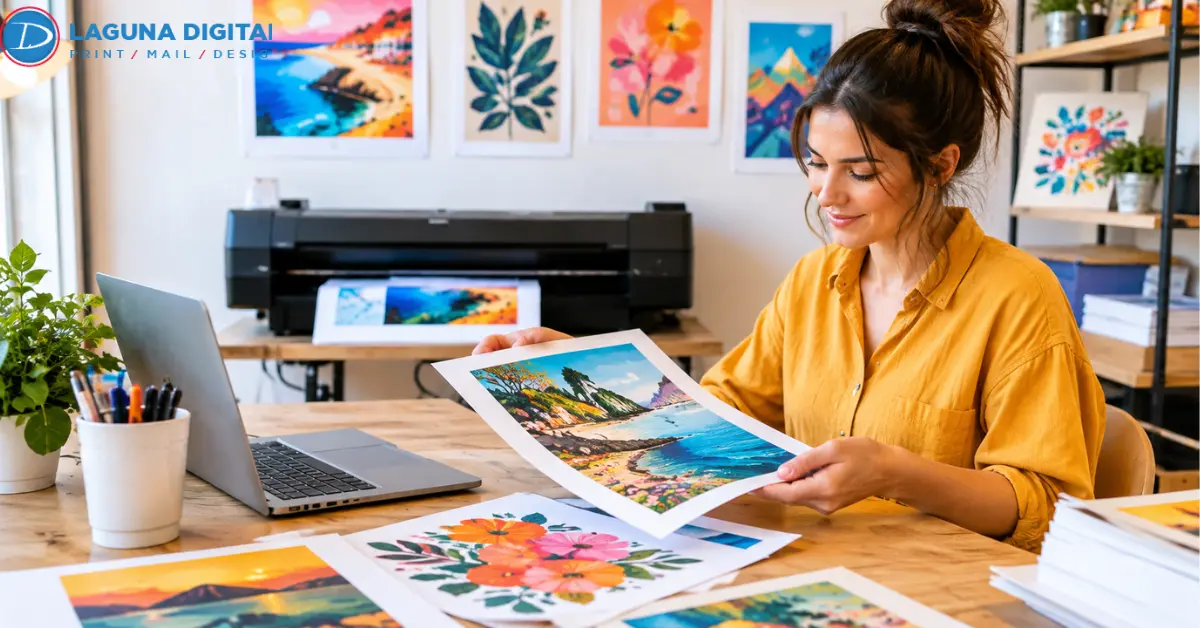
Most originals leave the studio once, and after that sale, the image earns nothing. A print business changes that, and starting one takes a careful scan and some patience with proofs rather than a big budget.
Buyers are close at hand, too. The United States accounted for 44% of global art sales by value in 2025, per the Art Basel and UBS 2026 report. What follows covers how to sell art prints online, seen from the print counter.
Start Your Print Business With Artwork Buyers Already Want
Pick the work that has already sold itself. An original that went within a week, or a painting strangers kept asking about at a weekend fair, has passed the only market test that matters. Start with three to five of those, since selling art prints of untested work is a gamble and every edition costs money to proof.
Medium affects how the work is reproduced. Flat watercolor or ink will reproduce clearly. However, heavy impasto creates small shadows beneath the scanner’s light bar and may result in an oddly flat reproduction. Gold leaf adds reflections to the image. For more information about reproducing artwork with metallic details, please refer to our guide.
Proportions are important also. An 8 x 10 and a 16 x 20 have the same 4:5 ratio. A 12 x 18 and a 24 x 36 also have the same 2:3 ratio. Therefore, a painting that fits into one of these two families may be sold in many different frame-ready sizes. If you create an artwork that is in-between, then you will need to either crop your artwork or have it custom framed.
Prepare High-Resolution Files For Fine Art Reproduction Printing
No retouching puts back detail a scan never caught. That fact alone sets the largest size a print business can honestly sell.
Scan Resolution
Flat, small original works will be scanned well by a desktop scanner. On the other hand, large format fine art scanners have a scanning bed that does not put pressure on the paint of your canvas or oversized work. You should scan your work prior to applying varnish, as the shiny surface of the varnish can cause glare to reflect off of the sensor.
Labs typically request 300 PPI (pixels per inch) for final print sizes. Therefore, you should always begin with the largest size that you intend to print. If you have a 9″ watercolor that has been sold at 27″, it is now three times its original size. To achieve 300 PPI for a 27″ print, you will need to scan it at 900 PPI.
Color Proofing
Screens lie sometimes. A computer screen emits light to your eyes; paper reflects light from the room. Therefore, a blue color that looked good on screen will usually print much darker than it appeared. Software soft proofing (using the lab’s ICC profile) can help catch most of that change in appearance.
The physical proof is viewed next to the original with 5000K daylight-balanced illumination, and the remainder of the color reproduction is verified. A good art reproduction service should provide a replacement proof if requested by the customer, and should do so without question. Do not approve the print until the proof is matched.
Choose Production Methods That Fit Your Print Business
A $6 notecard and a $300 signed giclée have little in common on the production side, so most sellers mix methods.
| Method | Best For | Quality Control |
| Giclée | Signed editions, 11×14 and up | High, with proofs you approve |
| Print on demand | Open-edition posters, merch | Limited to partner settings |
| Digital short runs | Postcards, notecards | Good, once proofed |
Giclée Versus Print On Demand
Giclée lays archival pigment ink onto cotton rag paper or canvas and remains the default for numbered editions. Local fine art printing services let you compare proof and original side by side and feel a paper like Somerset Velvet before choosing it. Many also take on custom art printing in odd sizes. Artists far from a lab can use fine art printing online, provided they order fine art prints as paper samples first.
Print on demand for artists removes inventory, since the partner prints and ships each order. The catch is margin, and you never see the print your customer opens. That trade suits a print-on-demand art business built on posters and tote bags, not a numbered series. Locally printed art postcards cover the cheap end better and give new fans a small first purchase.
Price Art Prints For Steady Profit And Collector Trust
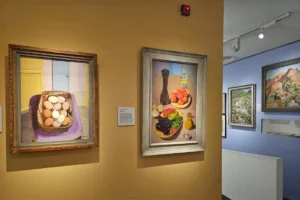
Andy Warhol understood the money side of art. His 1975 book, The Philosophy of Andy Warhol, puts it plainly. “Being good in business is the most fascinating kind of art.” Pricing is where an art print business proves it agrees.
To begin, calculate the total cost of your product. This includes the printing cost, packaging cost, and any shipping expenses you pay for directly. Then, multiply this total amount by two to determine your wholesale price and then again by two to determine your retail price. For example, if a giclee measuring 11″ x 14″ has a print cost of $30 and a packaging cost of $6, the total cost will be $36.
Edition Tiers
Open editions of smaller fine art prints keep the entry price friendly. Signed runs such as 12/50 sit higher, with a few artist proofs marked AP outside the count. Collectors care most about one rule. A sold-out edition never returns at the same size on the same paper. When you order fine art prints for a limited run, print as orders arrive and log each number.
Protect Your Artwork Before Your Print Business Goes Public
Images that have been posted online quickly produce copies. As of February 17th, 2026, the U.S. Copyright Office has allowed Group Registration of Two-Dimensional Art Works (GR2D), which allows for the registration of 2-20 works published during the same calendar year with a single $85 fee.
Revised fee schedule submitted to Congress in July of 2026; therefore, verify rates before proceeding. Owner of a U.S. work must register their work prior to filing an action for copyright infringement in a federal district court.
California has added a law to regulate editions. California Civil Code sections 1740-1745 regulate fine art multiple works (excluding frames) sold for at least $100. All multiple art dealers are required to inform their customers, in writing, if an item is a reproduction, as well as the total number of items produced in the edition.
Sell Art Online And Turn First Buyers Into Collectors
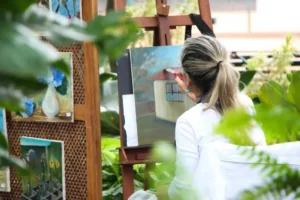
Selling art prints online mostly comes down to a shop that converts browsers and a list that brings buyers back to your print business. Use an artist website as home base and one marketplace for discovery.
Photos do most of the selling. Show the print framed on a wall for scale, then a close-up where the paper texture is obvious, and spell out the paper and edition size underneath. Ready-to-hang mounting on larger sizes tends to lift the average order, since plenty of buyers would rather skip the framer.
Repeat Buyers
The easiest people to get to buy your products again are the ones who have bought from you in the past. They already trust what you do. You should plan on having three or four product releases per year. When you release a new product, send out an email to your past customers 48 hours prior to releasing it to the general public.
Frequently Asked Questions
Is Selling Art Prints Profitable?
It can be, once the price covers every cost, fees included. After that, a print business with a working email list usually earns more per image than one living on social media likes.
How Much Should I Charge For Art Prints?
To determine your wholesale price, double the amount you paid to produce the product. Then, to find your retail price, double the wholesale price. For example, if a print costs $18 to produce, it should sell for approximately $36 at wholesale and $72 at retail. When quoting prices for non-standard size products (i.e., custom art prints), always use the term “custom art print” instead of just “print”.
What Resolution Do I Need For Fine Art Prints?
The target PPI for the final product should be 300. To create a print that is three times wider than the original, you will need a 900 PPI scan.
What Is The Difference Between A Giclée And A Regular Print?
A standard print is generally made with dye-based ink or toner on non-acid-free paper. On the other hand, Giclée prints use archival-quality pigment-based inks on acid-free cotton rag or canvas. As such, Giclée prints will retain their detail and color much longer than standard prints, making them the preferred method for reproducing fine art as signed works.
Is Print On Demand For Artists Worth It?
For testing out your ideas and for selling products, yes. When starting out as an online artist, having a print-on-demand-based business can help because you won’t have to carry any inventory. However, if you are looking to create numbered editions of your work, I would suggest that you either find a local printer who can produce those for you, or find a reputable online print lab that provides high-quality fine art prints.
Bottom Lines
Start smaller than you think. Three proven images, each scanned for the largest size you’d sell and proofed until the color holds, make a strong first release. Price from real costs and plan the next drop before the first sells through.
Laguna Digital has offered fine art printing services in Orange County for more than 15 years. The studio scans originals up to 60 x 80 inches without contact and proofs giclée editions against the original before printing. Bring in the piece you’re most sure of and request a quote this week.