



A painting does not have to earn only once. The original can remain unique while a professionally made giclée print gives more buyers access to the image at a lower price. Profit, however, depends on more than printing. Demand, capture quality, proofing, edition control, pricing, and fulfillment must work as one system.
A giclée print is a high-resolution inkjet reproduction produced from a carefully prepared digital file on a suitable fine-art surface. The term does not guarantee quality by itself. The result is shaped by the scan or photograph, color control, paper or canvas, ink, proofing, and handling.
Choose Artwork With Proven Demand
The best candidate is not always the artist’s favorite. Stronger signals include repeated inquiries, requests for a smaller version, exhibition interest, a quick original sale, or consistent saves and shares from the right audience.
Before ordering a batch, test two practical sizes through an interest page, email poll, or short preorder window. The goal is to learn which image attracts serious buyers and which format they prefer.
Professional fine art printing becomes profitable when the production plan follows this evidence. Once demand is clear, the next task is preserving the original well enough to support a premium sale.
Capture the Original Accurately
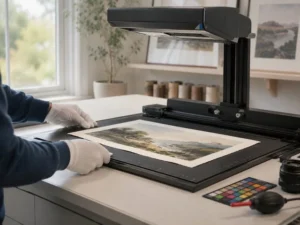
The digital master controls every later copy. A phone image may look acceptable on screen while still containing glare, lens distortion, uneven lighting, weak shadow detail, or inaccurate color.
Flat work may suit professional scanning. Large canvases, textured oils, metallic pigments, or varnished surfaces may require controlled photography or an art scanning service. A qualified art reproduction agency should explain the capture method, color workflow, final resolution, and largest safe output size.
The master should preserve proportions, brushwork, texture, neutral tones, shadow detail, highlights, and signature placement. This is also the stage to confirm reproduction rights. In the United States, creators generally own copyright in original work once it is fixed in a tangible form, unless a contract, license, employment arrangement, or written transfer changes that position.
After the file is prepared, production should pause until a physical proof confirms that the art reproduction works on the chosen surface.
Approve a Physical Proof
A monitor emits light; paper reflects it. That difference can make a file appear brighter on screen than it does in print. Deep blues may turn nearly black, pale colors may lose separation, and subtle texture may disappear.
Compare the first giclée print with the original under stable lighting. Check color, tonal detail, crop, border, size, signature position, and surface texture. When paper choice is uncertain, compare two samples.
Giclée printing is valuable because it can deliver repeatable results from a controlled file. It does not make every output premium. Claims such as museum quality prints should be supported by clear information about ink, paper, canvas, handling, and display conditions.
Once the proof is approved, lock the file and production notes. Moving between unrelated digital printing solutions without another proof can change color, trimming, or surface appearance.
Set Edition Rules Before Selling

An open edition has no fixed final quantity. A limited edition sets a maximum in advance and should not be enlarged after buyers purchase under that promise.
For limited edition prints, decide the total quantity, available sizes, artist’s proofs, numbering format, certificate details, signature location, and replacement policy before launch. Each giclée print should then be recorded by number, size, buyer, sale date, and price.
A spreadsheet can prevent duplicate numbering, show remaining stock, and protect buyer trust. Fine art reproduction becomes more credible when its records are as controlled as the image.
Price From Complete Costs
The printer’s invoice is only part of the cost. Capture, retouching, proofs, paper, ink, certificates, packaging, payment fees, marketplace fees, labor, insurance, and replacements all affect margin.
Use this formula:
Selling price = total unit cost + selling expenses + target profit
Consider an illustrative example. Twenty fine art prints cost $720 to produce, or $36 each. Packaging adds $8, selling fees average $9, and a replacement allowance adds $4. The real unit cost is $57. At a $75 selling price, only $18 remains before marketing time and overhead. At $110, the edition has more room to absorb promotion and damaged shipments.
This is not a universal price. It shows why pricing should begin with actual numbers rather than another artist’s retail figure. Custom art printing should support several price levels, such as a small open edition, a mid-size signed option, and a larger numbered release.
Build a Product Page That Removes Doubt
The sales page must explain exactly what the buyer will receive. Room mockups help with scale, but they cannot replace accurate product details.
Include the title, original medium, printed image size, full sheet or canvas size, material, ink process, edition status, signature, numbering, certificate, framing status, production time, packaging method, care guidance, and damage policy.
Photograph a second giclée print from the front, at an angle that shows texture, and in a realistic room. Add close details and scale. Fine art prints should not rely only on a cropped digital image.
Clear wording must distinguish the reproduction from the original painting. A dependable art reproduction agency can provide the technical information needed for the listing and future reorders.
Launch With a Measured Sales Plan
A profitable launch does not require a large first batch. It requires a controlled sequence:
- Offer early access to existing collectors and subscribers.
- Open a short preorder window for the most requested size.
- Produce the approved quantity.
- Photograph the finished edition and packaging.
- Release remaining stock to the wider audience.
- Review sales and customer questions before reprinting.
This protects cash flow and shows whether buyers respond to size, price, scarcity, or presentation. Art prints sell better when the original, process, and edition limit are clear.
Avoid investment claims or fixed longevity promises unless they are supported by the actual materials and testing.
Protect Quality During Fulfillment

The edition is not complete when it leaves the printer. It is complete when the buyer receives it in the promised condition.
Inspect color, trim, numbering, signature, certificate, and surface condition before packing. Works on paper need clean protective materials and rigid support. Rolled pieces need a strong tube that prevents crushing and movement.
For reorders, return to the approved file and production notes. A different large art scanning service or new capture is appropriate only when the master is no longer suitable. Any material change requires another proof.
Reliable digital printing solutions support repeatability, but the artist still controls the standard. Practical care guidance should accompany museum-quality prints, especially advice about direct sunlight, unstable humidity, heaters, and vents.
Create More Than One Revenue Path
One approved master can support several clearly separated offers:
- Small open-edition art prints for first-time buyers
- Mid-size signed giclée prints for established followers
- Large limited edition prints for collectors
- Hand-embellished versions with disclosed additions
- Licensed uses for approved commercial projects
Each offer should serve a distinct buyer. Fine art printing works best when the entry option remains strong, and the premium option has a real reason to cost more. A second custom art printing order should follow sales records, not optimism.
Frequently Asked Questions
What Makes a Giclée Print Different From a Regular Print?
Giclée printing uses a high-resolution file and controlled inkjet output on a suitable fine-art surface. Its value comes from capture quality, color management, ink, material, proofing, and consistency.
How Much Does It Cost to Produce Giclée Prints?
Cost depends on capture, retouching, proof size, final dimensions, material, quantity, finishing, and shipping. Request an itemized quote and calculate the break-even point before setting the retail price.
Is Paper or Canvas Better for Fine Art Reproduction?
Paper often suits watercolor, drawing, photography, and highly detailed work. Canvas may suit oil or acrylic painting when texture supports the image. The final choice should be based on side-by-side proofs.
Should an Artist Choose an Open or Limited Edition?
Open editions favor ongoing availability and lower entry prices. Numbered editions create fixed supply and require stricter records. The right choice depends on demand, audience size, pricing, and long-term release plans.
What Should a Certificate of Authenticity Include?
A certificate should state the artist, title, year, dimensions, material, edition number, total edition size, signature, and date. The artist’s internal record should match it exactly.
Wrapping It Up
Income from reproduced artwork comes from a connected process. Demand determines the image and size. Accurate capture protects the work. Proofing confirms color and surface. Edition rules protect trust. Complete costing protects margin. Clear listings and careful fulfillment protect the buyer’s experience.
Select one painting with proven interest, request an itemized capture and production quote, approve one physical giclée print, calculate the break-even price, and open a limited preorder before purchasing a larger batch. That sequence replaces guesswork with evidence and turns one finished painting into a repeatable product.