
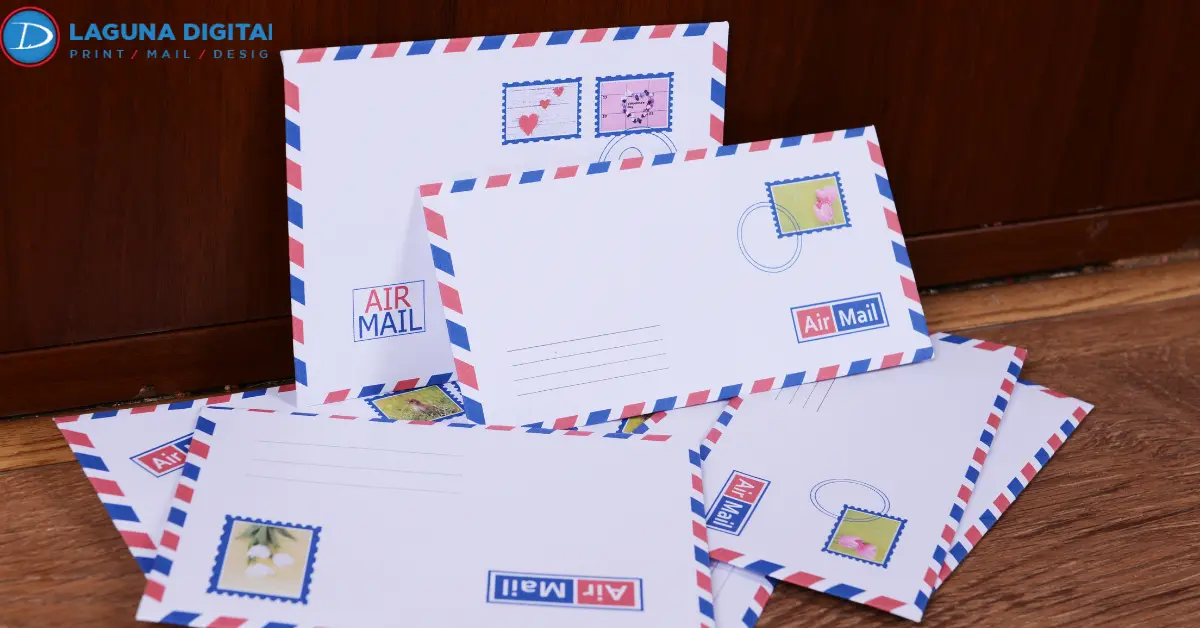
Direct mail still averages a 4.4% response rate, according to the ANA/DMA Response Rate Report. Two campaigns can carry the same offer and land on opposite sides of that number. The outer wrap is often why.
Direct mail envelopes determine whether a message gets opened and set the USPS charges to move it. Format is a budget question before it is a design one. Postage figures below reflect USPS rates effective July 12, 2026.
Which Envelopes Win Most Direct Mail Campaigns?
For most U.S. campaigns, the answer is the #10, at 4.125 by 9.5 inches. It includes a sales letter, a lift note, and a reply piece in the cheapest postage tier, which is what makes its cost per response so hard to beat. A 6 by 9 gives designers more room and still prices as a letter. Save the 9 by 12 for offers rich enough to absorb double the postage.
One rule sits behind that ranking. Envelope sizes are priced in tiers, not by the inch, so a piece crossing a boundary by a sixteenth of an inch pays what a piece three inches over pays.
How USPS Postage Rules Decide Your Envelope Budget?
The Letter-Rate Ceiling and What Breaks It
USPS holds a piece at the letter rate as long as it is under 6.125 inches high, 11.5 inches long, and 0.25 inches thick, weighs 3.5 ounces or less, and remains rectangular. One ounce costs $0.82 with a Forever stamp, or $0.78 metered. Break a single limit, and it becomes a flat, starting at $1.63.
On a 5,000-piece drop, that reclassification adds more than $4,000, and it tends to appear late. A spec sheet describes an empty envelope while the mail stream sees a stuffed one, so anyone ordering bulk mailing envelopes should weigh a filled sample early. Data deserves the same care, because postage is charged even on an address that no longer exists. Mailing list cleanup removes that waste before printing starts.
The Machinability Test That Adds 49 Cents
Size and machinability are scored separately, so a piece can clear every dimension and still fail. The test divides length by height, and the answer has to fall between 1.3 and 2.5. Anything square scores 1.0 and fails on shape, as do clasps, strings, rigid inserts, and uneven thickness. Those pieces still get delivered, but each carries a $0.49 nonmachinable surcharge under USPS Notice 123.
Square mailing envelopes photograph beautifully and read badly on an invoice. Nothing forbids the shape. It simply has to be priced before artwork is approved. Presorted First-Class letters run near $0.69, and Marketing Mail automation letters drop to roughly $0.37 once your printed mailing envelopes meet every automation standard.
Envelope Types That Earn Back Their Postage
| Format | Size | Postage tier | Best fit |
| #10 | 4.125″ x 9.5″ | Letter | Sales letter plus reply device |
| 6 x 9 | 6″ x 9″ | Letter | Brochures, stronger mailbox presence |
| A7 | 5.25″ x 7.25″ | Letter | Invitations, renewals, VIP mail |
| 9 x 12 | 9″ x 12″ | Flat | Contracts, catalogs, high-value offers |
The #10 and 6 by 9 Workhorses
The #10 stays the default for business envelopes because the whole system is built around it. Inserters run it fast, reply pieces nest inside without extra folding, and recipients read it as correspondence rather than advertising. The 6 by 9 keeps those advantages and adds room for a brochure.
When a 9 by 12 Flat Is Worth Double
Bigger formats buy attention with money. ANA data has kept oversized formats at the top of the response table for over a decade, with letter-size pieces near 4.3%. At flat pricing, though, a 9 by 12 must earn nearly twice the response of a #10 to break even, which limits it to contracts, catalogs, and high-value offers. Where privacy does not matter, a self-mailer covers similar ground for less.
The A7 works on a different principle. It suits renewals, reminders, and invitations, and it sits with the rest of a company’s printed business essentials rather than in the promotional pile. Marketing envelopes of that kind succeed because nothing about them looks like advertising.
Envelope Design Rules That Keep Mail in Automation
Window Placement and the Tap Test
Most guides to direct mail envelopes stop at color and teaser copy. The rules that send mail back to the sender live in the USPS Domestic Mail Manual, and window placement is the first. USPS Publication 25, Section 3-9 requires the delivery address to stay
“completely visible through the window throughout the full range of movement”
That movement belongs to the insert, not the envelope. Hold a sealed sample, tap all four edges, then check that the address still shows an eighth of an inch of clear space. Pieces that fail the tap test can be returned as nonmailable.
Three Print Rules That Fail Quietly
None of these appear in a normal design review, and all three cost nothing to fix while artwork is still open.
- The bottom right corner, 4.75 inches wide and five eighths of an inch tall, stays clear for the Intelligent Mail barcode.
- Dark, flood-coated custom envelopes need a white or very light address panel. Without one, the scanner rejects the piece.
- Address type set at 8 point or larger, left-aligned and sans serif, with no italics or script.
Color still earns attention once it stays out of the address block. Test color and envelope sizes separately so you can see which one moved the number.
Envelope Paper Weight, Closure and Print Method

Choosing Stock That Survives the Mail Stream
Two envelopes of the same size often perform differently, and stock explains why. Weight, opacity, and closure decide how a piece looks on arrival.
- 24 lb wove is the working minimum for letter-rate mail. At 20 lb, the insert shows through, and the piece creases in transit.
- 28 lb feels substantial in the hand, which suits financial, legal, and high-ticket offers.
- A security tint hides the contents when the insert carries a check or a card number.
- Peel-and-seal flaps speed hand fulfillment on short runs. Gummed flaps cost less and travel better through inserters.
Matching the Press to the Run
Run length decides the press. Offset turns cheaper past roughly 10,000 pieces, while digital printing handles short runs and versioned copy without new plates.
One detail is worth settling before artwork is approved. If ink runs to the edge, custom printed envelopes must be printed flat and converted afterwards. Pre-converted stock leaves an unprinted margin near the seams, so ask your custom envelope printing supplier which route the job takes.
Your Checklist Before Approving an Envelope Order
Every item below has repriced a job at some point. Work through them before any direct mail envelope printing job reaches the press.
- Weigh a fully stuffed sample and confirm its postage tier.
- Measure thickness with every insert loaded. A quarter of an inch is the ceiling.
- Run the tap test on a live sample from the production run, not the proof.
- Update addresses through NCOALink within 95 days of the mail date, as USPS requires for presort pricing.
- Register for a USPS promotion first. Integrated Technology and Continuous Contact each pay 5% through December 31, 2026, and Informed Delivery adds another 1%.
- Order 10% overage because inserters damage printed mailing envelopes on every run.
- Test two envelope types at a time and keep both halves of the list matched. ANA benchmarks put house lists at 5% to 9%, and prospect lists at 2% to 4.4%.
Where Jobs Usually Slip
Step two catches more work in our shop than any other. The envelope clears its own specification, then a folded reply piece pushes the stack past a quarter inch. Printers offering full direct mail service absorb steps one through four inside the job, so ask whether presort and address work are quoted or billed on top. Bulk mailing envelopes priced without them rarely finish cheaper.
Frequently Asked Questions
What Size Envelope Is Best for Direct Mail?
The #10 suits most campaigns, carrying a letter, a lift note, and a reply piece at letter rate. Move up to a 6 by 9 for more room, and to a 9 by 12 only when the offer covers flat postage.
Do Window Envelopes Hurt Response?
Not by themselves. Windows read as transactional, which lifts open rates on statements and renewals, though they underperform on aspirational offers. Many teams use window business envelopes for reminders and closed-face for promotions.
Do Colored Envelopes Get Opened More Often?
Color helps a piece get noticed, although no independent study names a winning shade. Test color against your control, and keep the address dark on a light field. That rule covers all marketing envelopes, not just bright ones.
What Does It Cost to Print and Mail 5,000 Pieces?
Printing cost moves with ink coverage, stock, and run length. Postage is the larger line item, roughly $0.37 to $0.47 per piece at Marketing Mail automation rates and near $0.69 at presorted First-Class. Ask vendors to quote direct mail envelope printing and postage together.
What Paper Weight Should I Choose?
Use 24 lb for standard letter campaigns and 28 lb when the offer is high value or the insert is thick. Add a security tint when payment details are enclosed, and request a stock sample before ordering custom printed envelopes.
To Sum Up
An envelope carries the first impression a prospect evaluates, and it sets the postage tier that decides whether a campaign pencils out. Settle size and machinability first, then spend the creative budget where the sorting equipment has no opinion.
Bring your list count, insert count, and mail date to Laguna Digital and ask for one number covering custom envelope printing, presort, and postage. If the format is still open, order a short run of custom envelopes in two sizes and let response data settle it.