


A sign can look perfect on the proof and still be wrong for the location. The material may be too light for an exposed fence, too costly for a six-week campaign, or too sensitive to heat for a sun-facing wall. That is why choosing a rigid panel for exterior advertising should begin with the site, not the product list.
For long-term exterior use, aluminum and aluminum composite material are usually the strongest starting points. Corrugated plastic suits temporary campaigns. Rigid PVC fits many protected or medium-term locations, while acrylic is better reserved for selected architectural uses.
A 24-inch directional panel beside a sheltered entrance does not face the same load as a 4-foot property sign on an open fence. Wind, direct sun, irrigation, road spray, mounting height, and message life all affect the specification.
Start With Exposure, Size, and Service Life
Before ordering outdoor signs, record three things. First, how long the message needs to stay up. Second, what the panel will face each day. Third, how it will be supported.
Direct sun, road spray, sprinklers, wind, and temperature swings all matter. A parking notice read from 15 feet away can carry more detail than a roadside panel seen from a moving vehicle.
This is where good signage separates from a generic print order. Permanent business signs justify more thought about thickness, edge condition, hardware, and finish. Short campaigns can use lighter custom signs without paying for a service life the project does not need.
Traffic-control applications follow different rules. Regulatory, warning, and guide signs may fall under MUTCD requirements, so a promotional panel should not substitute for a required traffic-control device.
Aluminum Suits Permanent, Exposed Locations
Solid aluminum is a dependable choice for parking notices, facility identification, directional panels, and other display signs that remain outdoors. It resists rust and holds a flat face well when the gauge and support are appropriate for the panel size. Sign-grade sheets are commonly sold in several thicknesses, so aluminum by itself is not a complete specification.
The more useful question is how the panel will be finished and mounted. Hole position, coatings, posts, and fasteners can matter as much as the sheet.
For permanent advertising signs, the choices involved in aluminum sign durability and finishing belong in the specification before artwork is approved. A durable face attached with the wrong hardware is still a weak installation.
ACM Works Well for Larger Flat Panels
Aluminum composite material uses thin aluminum faces around a rigid core. It is lighter than a comparable solid-metal panel and stays notably flat, which is why it is common on storefronts, property identification, wayfinding, and commercial signs. Vanderbilt lists 3 mm and 6 mm among common ACM thicknesses.
ACM is not simply cheaper aluminum. The core changes how the sheet behaves, how cut edges are handled, and how the panel should be supported. A broad storefront fascia also catches more wind, so material and fastening should be decided together.
Corrugated Plastic Is Best When the Campaign Has an End Date
Corrugated polypropylene earns its place through low weight, low cost, and fast installation. It is commonly used for real estate, elections, event directions, opening notices, and promotional signs. A 4 mm sheet is a common choice for ground-mounted applications and works with wire stakes because the stake legs run into the flutes.
That convenience has limits. Wind can work the stake and flutes, handling can crush edges, and exposed sheets can flex.
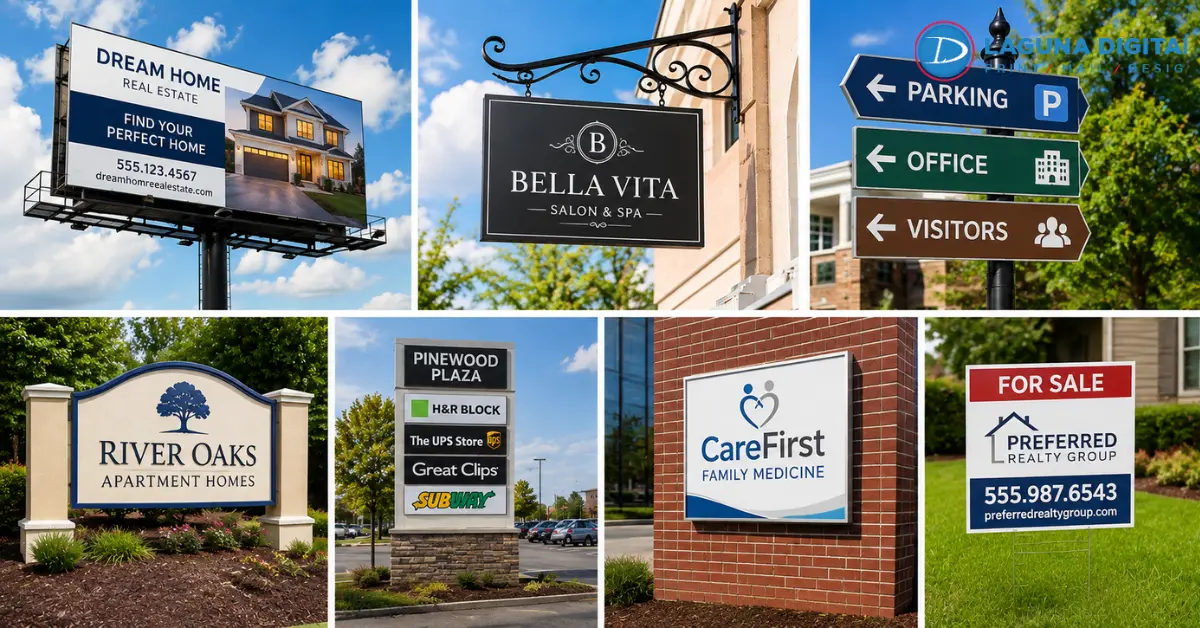
Real estate shows the material at its best. Effective real estate yard sign design depends on a short message, strong hierarchy, and roadside visibility. Good yard signs are often simpler than clients first expect because the viewer may only have a few seconds to read them.
PVC Is Useful, but Location Matters
Rigid PVC foam board provides a smooth printed face without the weight of metal. It is used for menu panels, retail graphics, sheltered wayfinding, event pieces, and selected outdoor displays. Vanderbilt describes PVC board as suitable outdoors for short-term use, while other sign shops use it more broadly in protected or medium-term settings.
The key limitation is exposure. Heat, full sun, unsupported span, and impact risk can change whether PVC is sensible. A small panel under an awning and a large board on an open fence should not receive the same recommendation.
That is why PVC plastic signs for business displays should be considered in terms of thickness, placement, and support. Acrylic looks more polished but needs careful mounting and is less forgiving of impact.
Print and Mounting Often Decide How Long the Sign Looks Good
The substrate is only one part of exterior performance. Poor sign printing can leave a sturdy panel with weak contrast, fading graphics, or type that cannot be read at the intended distance. AlphaGraphics notes that the print layer, laminate, and hardware may fail before the underlying panel in long-term exterior work.
This matters for marketing signs beside roads and driveways. One message should dominate. A phone number, QR code, offer, and service list cannot all compete at the same visual level.
The same principle applies to wall signs above eye level. Judge artwork from the real viewing angle. Better material cannot rescue a headline that is hard to read.
Buy for the Job, Not for the Cheapest Square Foot
The lowest initial price is not always the lowest project cost. Replacing a temporary substrate adds new printing and installation. The opposite mistake is just as common. A six-week event does not need a panel engineered for years.
For long-term outdoor advertising, aluminum or ACM will usually be the first comparison. Temporary outdoor signs often point toward corrugated plastic. PVC becomes more attractive when exposure is controlled, and a smooth rigid face is needed.
Once aluminum is the confirmed material, custom aluminum sign options such as coating, drilled holes, rounded corners, and accessories can be chosen around the installation rather than added after production.
Give the Printer a Real Specification
A useful quote for rigid signs needs more than width and height. Provide the location, finished size, expected service period, viewing distance, material preference, print method, finish, mounting surface, quantity, and clear site photographs.
That information keeps signage consistent across several formats. Permanent business signs may use metal while temporary promotional signs use corrugated plastic, yet both can share the same colors, typography, and directional language.
For temporary ground placement, 4 mm corrugated plastic yard sign options are appropriate once size, quantity, and stake style are known. Other custom signs on the same property may use ACM or PVC without making the visual system feel disconnected.
A complete brief makes sign and banner printing services easier to quote accurately because the material and finishing can be matched to an actual installation rather than a vague request.
Check the Rules Before Fabrication
Local sign codes can regulate size, height, placement, illumination, and permits. Traffic-control signs are separate. The current federal reference is the MUTCD 11th Edition with Revision 1, dated December 2025.
That distinction matters for commercial signs near parking lots, drive aisles, and road access points. A branded directional panel should not be assumed to satisfy requirements for a regulatory or warning device.
The final artwork also deserves a distance check. Display signs should be judged from where people stand or drive. Advertising signs need one clear first message, while entrance outdoor displays can carry more detail.
Frequently Asked Questions
What rigid material is best for permanent exterior use?
Solid aluminum and ACM are the usual first choices. Aluminum suits many smaller permanent panels, while ACM works well for larger flat faces. Size, exposure, mounting, and service life should decide the final specification.
Is corrugated plastic suitable for long-term use?
It is better treated as a temporary material. It works well for campaigns, real estate, events, and short directional use, while permanent applications usually justify a stiffer substrate.
Is PVC suitable for exterior use?
Yes, when the location suits it. PVC is strongest in protected, shorter-term, or medium-term applications. Full sun, high heat, unsupported spans, and impact exposure need consideration.
What makes exterior graphics easier to read?
Strong contrast, adequate letter size, a short message, and a clear information order matter most. Marketing signs viewed from a vehicle need less copy than signs beside a pedestrian entrance.
What should be sent to a sign printer?
Send finished dimensions, quantity, site photographs, expected service period, viewing distance, mounting surface, material preference, finishing needs, and artwork status. Those details let a printer recommend the build instead of pricing from size alone.
Conclusion
Good sign printing starts before ink reaches the panel. The location, service period, material, artwork, and mounting should agree with one another. Aluminum and ACM handle many permanent jobs well. Corrugated plastic keeps short campaigns practical. PVC fills the gap where a smooth rigid face is needed without specifying metal.
For wall signs and yard signs alike, document the site before requesting production. That short step makes material and hardware decisions much easier. Laguna Digital can use those project details to produce exterior panels that fit the way the finished piece will actually be installed and used.