

The Best Outdoor Banner Materials for Durability and Visibility

Bolt a 4′ x 8′ banner flat to a stucco wall and the wall carries the load. Zip-tie that same banner to a chain-link fence and wind hits both faces at once. Every gust pulls on four grommets.
That is the whole decision. On supported surfaces, 13 oz scrim vinyl covers most outdoor banner printing. Where wind reaches both sides, mesh is safer. Fabric belongs under an awning.
How to Choose an Outdoor Banner Material?
Five details settle the question faster than any comparison of banner materials:
- Finished size, in inches, width first
- Mounting surface: wall, chain-link, frame, poles or scaffold
- Wind exposure: sheltered, open on one side, or open on both
- Viewing distance: 10 feet from a doorway, or 150 feet across a lot
- Display time: one weekend, one season, or two years
Give a print rep those five answers and the stock picks itself.
Skip them and the default instinct takes over: heavier must be stronger. That instinct is wrong more often than people expect.
Vinyl Banners
Solid vinyl gives the press an uninterrupted surface. Logos stay sharp. Photographs hold detail. The small type stays readable.
Scrim is the woven polyester grid inside the sheet. It stops the banner stretching out of shape or tearing away from a grommet.
When 13 oz Scrim Vinyl Is Enough?
At 13 oz, the stock is usually rated three to five years outdoors.
That covers storefront promotions, school fundraisers, sponsor walls and most everyday outdoor signage. It is also the cheapest route to a big, clean image, which is why most vinyl banner printing starts here.
The 13 oz and 18 oz cover the common outdoor weights, and standard sizes often print same day or next day.
When 18 oz Vinyl Is Worth the Cost?
An 18 oz matte sheet adds thickness, opacity and puncture resistance.
Two situations justify it. A banner that gets rolled, stored and re-hung several times a year. Or one hanging over a dark surface, where you do not want anything ghosting through the face.
What it will not do is beat the wind. A heavier sheet catches the same air as a lighter one, because the surface area has not changed.
On an exposed site, the upgrade buys a tougher banner attached to the same four grommets. The failure point just moves to the corners. PVC banners give out at their anchor points far more often than they tear in the middle.
Mesh Banners
Stretch solid vinyl across open fencing and you have built a sail.
Wind presses into the face. The load transfers to the hem, then the grommets, then the fence itself.
Mesh vinyl banners solve that at the material level.
Why Mesh Works on Fences and Scaffolding?
Perforated mesh lets a share of that air pass straight through. That is the whole reason mesh banner printing exists.
It makes 9 oz mesh the standard call for sports fences, construction perimeters and scaffolding. The perforated mesh is built for those installs.
Two details most product pages bury:
- Mesh prints on one side only. Light travels through the holes, so a second image ghosts through.
- Mesh does not need wind slits. Slitting solid vinyl is a field workaround that damages the print. Perforated stock is the engineered version of the same idea, and the usual choice for large format printing on fence wraps.
How to Design Artwork for Mesh?
Perforations remove printable surfaces. Hairline strokes, thin serifs and 10 pt legal copy break apart at distance.
Artwork for mesh vinyl banners wants a short headline, heavy contrast, oversized type and few small elements.
A file that looks fine on screen at 25% can read as texture from across a lot. That is the one real trade-off in mesh banner printing.
Fabric Banners
Polyester fabric prints beautifully. The finish is soft, it throws almost no glare under event lighting, and it folds into a box instead of shipping on a tube.
Where Fabric Works Outdoors
Outdoors, performance depends on the textile.
Polyester holds dirt, moves more in gusts, and varies in UV and water resistance depending on the coating. Unless the spec sheet rates it for prolonged exterior use, do not file it alongside weatherproof banners.
The fabric banner range suits covered entrances, hospitality events and backdrops seen up close.
How Hems, Grommets and Pole Pockets Affect Banner Life?
Material choice gets the attention. Finishing does most of the work.
Hems fold and heat-weld the edge, so the perimeter is double thickness where the hardware sits.
Grommets usually land every two feet. On anything wider than 6 feet, the corners take the worst punishment.
Pole pockets, commonly 3 inches, are the better call between poles or inside a frame. The load spreads across a full edge instead of four points.
Two habits worth adopting:
- Tie with bungee cords, not rigid zip ties, so the banner can move without ripping through a grommet.
- Check the local sign ordinance first. Some cities limit banner size and display duration.
What Size Should Banner Text Be?
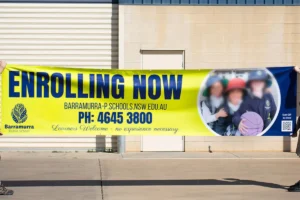
Durability means nothing if nobody can read the thing from where they stand.
The sign industry guideline is one inch of capital letter height per 10 feet of viewing distance. A banner read from 100 feet needs roughly 10-inch caps.
On a 4-foot-tall piece, that is a headline and maybe one line under it. Not five bullets and a phone number. On large format banners, the math gets stricter, not looser.
The International Sign Association reports that across a four-year study average, 54% of shoppers have driven past a business and failed to find it because the sign was too small or unclear.
Outdoor Banner Material Comparison
| Where it hangs | Start with | Why |
| Storefront wall or building face | 13 oz scrim vinyl | Full-surface print, dependable life span |
| School or community event | 13 oz vinyl | Versatile, folds and stores easily |
| Chain-link or open fencing | 9 oz mesh | Air passes through instead of loading the hem |
| Reused several times a year | 18 oz matte vinyl | Thicker, opaque, survives handling |
| Covered entrance or indoor event | Fabric or vinyl | Appearance and low glare take priority |
| Between two poles or in a frame | Vinyl with pole pockets | Load spreads across the full edge |
What to Confirm Before You Order?
- Exact finished size, and whether the file carries enough bleed for the hem
- Mounting method, settled before the layout is approved
- Finishing: hems, grommet spacing or pole pockets
- Whether the largest type clears the letter-height rule
- Whether large format banners need welded seams or reinforced corners
Two quick sanity checks before custom banners go to production. If the banner ties to an open fence, ask whether solid vinyl belongs there at all. If it sits flat against a building, ask whether mesh adds anything.
With large format printing, settle production and installation together. Finished dimensions affect seams, folding and shipping.
Frequently Asked Questions
What is the best material for an outdoor banner?
For walls, frames and moderately exposed sites, 13 oz scrim vinyl is the practical default. Mesh is better wherever wind reaches both faces. Fabric suits sheltered locations.
Is mesh better than vinyl outdoors?
On open fences and exposed spans, yes. Air moves through the perforations instead of loading the hardware. On a sheltered wall where detail matters, solid vinyl wins.
Is 18 oz vinyl better than 13 oz?
Not automatically. It adds body, opacity and puncture resistance for repeated handling, but it catches the same wind. In vinyl banner printing, choose the weight for the property you need.
Do PVC banners hold up in rain?
Yes. Vinyl is waterproof and UV-cured ink resists fading, which is why weatherproof banners are almost always vinyl. Service life comes down to mounting, tension and sun rather than rainfall.
How long do outdoor banners last?
Standard 13 oz vinyl is generally rated three to five years outdoors, and 18 oz can reach five. Real life depends on wind, direct sun, tension and storage.
To Sum Up
Outdoor banner printing is decided by the installation, not by a spec sheet. Solid vinyl for supported surfaces. Mesh wherever wind gets behind the face. Fabric where the weather is partly controlled.
Once the site is clear, choosing between banner materials is straightforward. Measure the space, confirm the mounting method, check the viewing distance, and size the headline to match.
Bring those four answers to Laguna Digital and you get outdoor signage built around the real install.
Request a quote with your dimensions and mounting surface, and your custom banners get specced in one call.