


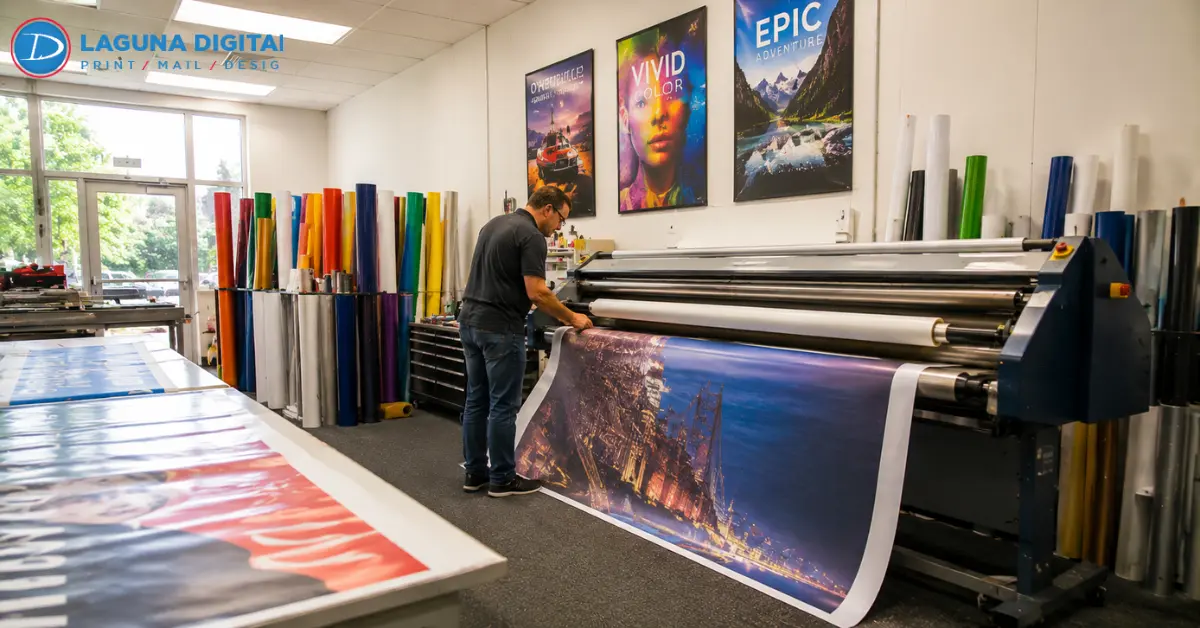
A poster’s maximum size is set by the width of the press, not by the design file. Most U.S. shops run roll media between 24 and 60 inches wide, and that measurement caps the short side of the finished piece.
Length stays flexible, since roll-fed machines feed several feet in one pass. That single limit explains most of what happens when you order large posters, including why poster printing quotes jump at certain measurements.
What Actually Decides the Maximum Size
Wide format equipment is graded by the widest media it accepts. Machines handling roughly 18 to 100 inches of media width carry the wide format label, while anything past 100 inches sits in grand format territory. Presses in commercial shops usually measure 24, 36, 42, 44, 54, or 60 inches.
Your short dimension has to fit inside that media width after the machine takes its grip margin, so a 60-inch roll yields close to 59 inches of usable area. The long dimension answers to roll length instead of the print head, so outputs of 60 to 120 inches are routine.
Ask for media widths before settling on unusual printing sizes. Large format printing is billed by the square foot, so a two-inch overage that pushes a job onto a wider roll lifts the price of the whole order.
Poster Formats Printed Across the United States
Most jobs never approach that ceiling. Five standard poster sizes handle the bulk commercial work.
| Size (inches) | Typical application |
| 11 x 17 | Bulletin boards, interior notices, campus announcements |
| 18 x 24 | Events, retail windows, real estate open houses |
| 22 x 28 | In-store promotions, easel and A-frame inserts |
| 24 x 36 | General advertising, the most requested commercial format |
| 27 x 40 | Theater one-sheet, lobby and cinema displays |
Retailers stock frames in these poster sizes, which keeps the display budget low. Ordering posters in a catalog format also skips the trimming charge attached to off-list measurements.
Sizes That Run Past the Standard Range
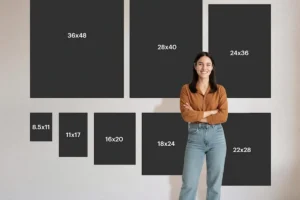
Above 27 x 40, viewing distance replaces frame availability as the deciding factor. The large poster sizes requested most often are 30 x 40, 36 x 48, and 40 x 60, with 48 x 96 reserved for rigid panels.
Large format posters at this scale become trade show backdrops, lobby wall graphics, construction site announcements, and gallery reproductions. Past 40 inches on any side, the artwork needs a harder focal hierarchy, because a viewer reads it in about three seconds from across a room.
Substrate becomes structural too, since unmounted paper at that scale curls and tears at the corners. Our guide to custom banners, posters and signs shows how those choices play out in real storefronts.
Material Limits Worth Confirming Before You Order
Foam board, PVC, and gator board arrive as 48 x 96 inch mill sheets, so mounted work stops at that footprint unless panels get seamed on site. Canvas, fabric, and vinyl rolls obey the same width rules as paper.
Three questions clear up nearly every open point about poster dimensions before anyone opens a file:
- Which media widths does the shop run in house?
- Does the chosen stock exist in that width, or only in narrower rolls?
- Will the piece be laminated or mounted, and how wide is that equipment?
Question three causes more reprints than the other two combined. A lamination line is often narrower than the press beside it, so a 54-inch print may finish at only 25 or 38 inches. Any shop doing large poster printing on site answers all three in one call.
Matching Resolution to Viewing Distance
Oversized work does not call for oversized files. Required resolution drops as the viewer moves back, because the eye stops resolving fine detail at a distance.
| Viewing distance | Target resolution at final size |
| Under 3 feet | 150 to 300 ppi |
| 5 to 10 feet | 100 to 150 ppi |
| 15 to 30 feet | 50 to 100 ppi |
| Across a street | 15 to 30 ppi |
A 24 x 36 gallery reproduction studied at arm’s length earns the top of that range. A 40 x 60 lobby graphic read from 15 feet does not. Studios that print posters at large format poster sizes build artwork at one-tenth scale, then output at 1000 percent, which keeps files light while vector type stays sharp. Artwork that begins on canvas or paper should be captured first, and large-format scanning beats a camera copy every time.
Choosing a Size for the Space It Will Occupy
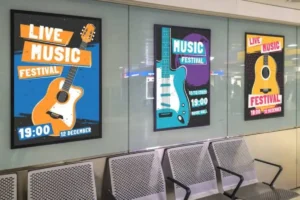
Indoors, measure the wall or frame before picking a format. An 18 x 24 or 24 x 36 settles comfortably into retail and office settings. Where floor space beats wall space, a retractable banner delivers comparable impact from a portable base.
Outdoors, uncoated paper fails within days. Exterior work needs vinyl or synthetic stock, UV-stable inks, sealed edges, and hardware rated for local wind load. Custom posters earn their cost whenever the opening is a nonstandard measurement, common in older storefronts and built-in cases.
Measure it, then take a quarter inch off each side for the frame lip. Large poster dimensions pulled from a real tape measure prevent the worst outcome here, a flawless print that will not fit where it was meant to go. The same measure-first logic governs any vinyl banner built for an exterior wall or fence.
Finishing Work That Changes What You Can Order
Finishing happens after the ink, so it adds a second set of size limits.
- Laminate film adds scuff resistance and moisture protection. Gloss lifts color saturation, while matte cuts glare under retail lighting.
- Mounting bonds the print to a rigid board so it hangs without a frame. Mounted posters are the usual pick for trade shows and lobby installs.
- Grommets and hems apply to flexible stock, spaced every 24 to 36 inches.
Lock the finishing width before approving a print size. Sequence matters in every poster printing project, because a laminator narrower than the output leaves a piece that cannot be finished without trimming. Shops keeping large format printing and finishing under one roof catch that clash while quoting rather than at pickup, and the same holds for oversized signs and banners needing hems, poles, or grommet spacing settled in advance.
Preparing Files for Oversized Output
- Build at final trim size, or an exact fraction of it, and state the scale in the file name.
- Allow 0.125 inch of bleed on standard printing sizes, 0.25 inch above 24 x 36.
- Hold text and logos at least 0.5 inch inside the trim line.
- Convert to CMYK and flag any spot color that has to be matched.
- Outline or embed every font, then export a flattened PDF/X file.
- Check effective resolution at 100 percent of the final poster dimensions, not at working size.
Files that are not press-ready cost more to fix than to rebuild. A graphic design team can redraw artwork at scale, which beats upsampling a low-resolution original that never regains lost detail. Studios that print posters weekly keep a scaled master file for this reason.
Frequently Asked Questions
What is the largest poster that can be printed in one piece?
Roughly 59 inches on the short side by several feet on the long side, on equipment most commercial shops run. Grand format machines clear 100 inches. Past that, artwork gets tiled into panels installed edge to edge, with a half-inch overlap for alignment.
What are the standard poster sizes used by U.S. printers?
11 x 17, 18 x 24, 22 x 28, 24 x 36, and 27 x 40 inches. Those poster sizes match off-the-shelf frames, which is why they carry the lowest combined printing and display cost.
Are large posters cheaper per square foot than small ones?
Usually, yes. Setup is a fixed cost, so the square-foot rate falls as the piece grows. Stock, finishing, and roll fit matter more than size alone, and a job forcing a wider roll gives that saving straight back.
Can large format posters be used outdoors?
Yes, on vinyl, polypropylene, or coated synthetic stock printed with UV-rated inks. Standard poster paper is an indoor material. Durability at large format poster sizes depends more on substrate and lamination than on the ink itself.
How long does large poster printing take?
Single-piece work on stocked media often runs one to two business days. Custom posters on special-order substrate, or jobs needing mounting and lamination, take longer. Confirming large poster dimensions and finishing at the quote stage protects an event date.
Ready to Print at Full Scale
Three confirmed numbers settle the decision: the shop’s media width, the finishing equipment width, and the measured space where the piece will hang. Get those on paper and the format picks itself, whether you land on a catalog size or one of the large poster sizes above 40 inches.
Send your dimensions, substrate, and display location to Laguna Digital for a per-square-foot quote and a free file check before anything reaches the press. Upload your artwork today and have your posters printed, finished, and ready on the date you need them.