

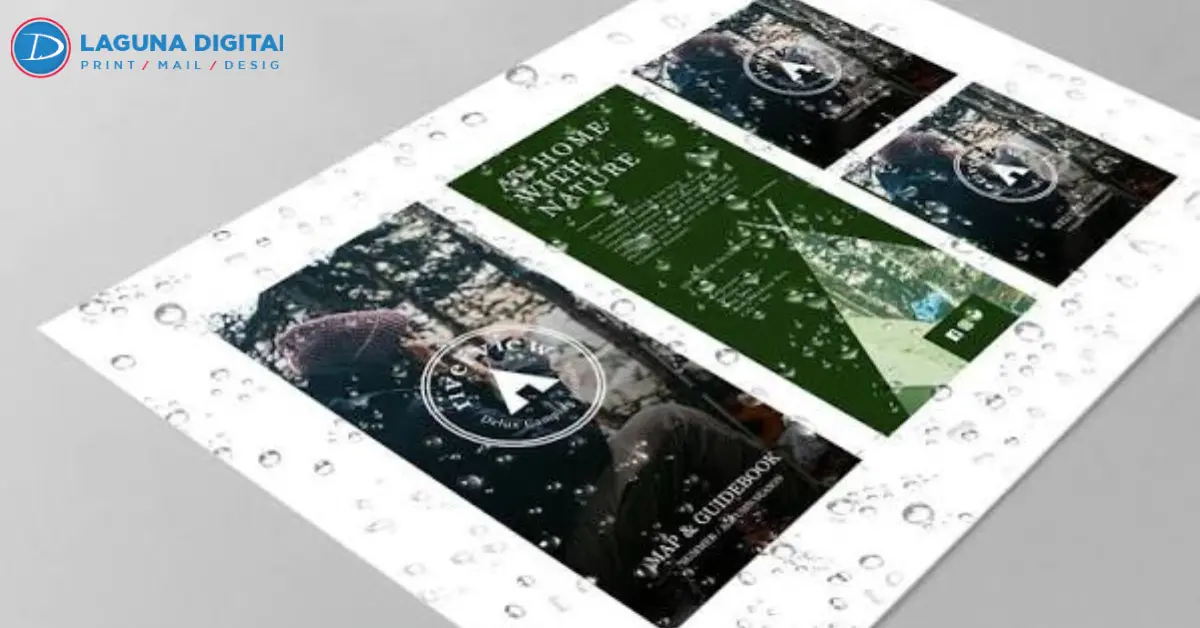
A restaurant menu comes back from a wipe-down with gray streaks. A bottle label blurs in an ice bucket. A yard sign runs after one night of rain.
All three jobs were sold as waterproof printing. All three failed within a week. The ink is rarely the guilty part. What matters more is the surface underneath, plus the hours before the first drop landed.
What is a Smudged Waterproof Print?
A print fails when only one part resists moisture, because water finds the weakest component. Pigment on uncoated stock still bleeds, since the sheet gave way. A laminated menu still stains, since the trimmed edge gave way.
Four Layers Decide Whether a Print Survives Water
Every finished piece stacks four things that moisture can attack.
- The substrate. Sheet, film, or board under the image.
- The colorant. Dye, pigment, toner, or cured resin.
- The bond. Whether color soaked in, sat on top, or fused down.
- The finish. Laminate, varnish, or nothing at all.
Most complaints trace to layer one or layer four. The right printing materials prevent more waterproof printing failures than swapping colorants ever will. Start with the colorant anyway, since it rules out in seconds.
Dye Dissolves, Pigment Holds Its Ground
Dye carries color dissolved in liquid, so water redissolves it, and the image travels. Pigment carries solid particles that never dissolve. Toner arrives as powdered plastic fused by heat, which shrugs off water but scratches off a slick surface.
Home photo printers ship with dye by default, which explains most kitchen-made labels that die in a cooler. Shops running wide-format digital printing reach for latex, eco-solvent, or UV-cure systems, where color locks into a cured film.
Pigment ink printing on the correct stock survives soaking. Put the same waterproof ink on the wrong stock, and it fails anyway. That mismatch drives most waterproof printing complaints, which points at the sheet.
The Paper Can Wick Even When the Ink Holds
Coated inkjet stock carries a receptive layer that pulls water-based color in fast. Add moisture later, and the layer softens, while fibers beneath act like a paper towel. The pigment held. The sheet carried it sideways. High humidity causes the same ink bleed without a spill.
Genuine waterproof paper is not paper. It is a synthetic sheet of polypropylene or polyester, non-absorbent through its thickness. Field checklists, clinic instructions, and restaurant menus belong on it.
Coated stock under an aqueous coating or laminate delivers water resistant printing. That grade survives splashes, condensation, and a damp cloth, never submersion. Confusing the two is the most common reason a buyer questions print quality after a storm. Waterproof printing that shrugs off immersion starts with the sheet.
Curing Time Is the Step Most Buyers Skip
A sheet can feel dry while remaining chemically unfinished. Solvent and eco-solvent inks release carrier fluid slowly, so the accepted outgassing window runs 24 to 48 hours. Laminate a banner four hours off the press, and trapped solvent produces hazing, silvering, and lifting edges that let water travel underneath. Rigid substrates dodge part of this, one reason PVC panels outperform thin poster board outdoors.
Same-hour lamination on a solvent job is a scheduling choice, never a technical one. Waterproof printing depends on that window more than buyers realize, and the piece pays for skipping it.
Why Lamination Alone Leaves an Open Edge
Lamination bonds clear film across the printed face, stopping abrasion and blocking UV. Then the piece gets trimmed, exposing raw paper core along every cut.
Stand that edge in water and capillary action pulls moisture inward. The core swells, film separates, delamination spreads. Waterproof labels on chilled bottles fail this way, since condensation pools where the film stops.
Two fixes work. Flood the film past the trim line so it seals to itself, standard practice in quality lamination work. Or delete the paper core. Durable printing on custom vinyl or BOPP skips laminated paper, which is why serious waterproof stickers cost more and outlast it by years.
When the Damage Was Never Water at All
Plenty of pieces blamed on failed waterproof printing never met water. They met a bleach wipe, a degreaser, alcohol, sunscreen, or a dishwasher. Chemical resistance is a separate property from moisture resistance. Fade resistance is separate again, since sunlight breaks down colorants that shrug off rain.
Abrasion finishes the job. Wet rubbing lifts the color that standing water leaves alone, so a menu wiped forty times a day fails from friction. High-touch pieces such as professional name tags need a matte laminate or a thermal transfer print.
A Six-Step Wet Test Before You Approve the Run
Durability claims are cheap to verify. Run this on a proof made from the exact stock and press booked for your job.
- Wait 24 hours. Testing a fresh sheet measures dry time, not water resistance.
- Drip water. Place three drops on a dark solid, wait 60 seconds, then blot.
- Rub while wet. Drag a damp thumb across that area ten times.
- Soak the edge. Stand a trimmed sample in a quarter-inch of water for two hours.
- Wipe with the real cleaner your staff uses in service.
- Chill a label. Apply one to the real container, refrigerate it, then check for edge lift.
Six checks, one afternoon. The protocol catches nearly every waterproof print failure while a reprint is cheap, protecting print quality across the run.
What to Ask Before You Sign Off
- Which ink system runs this job, dye, pigment, toner, latex, or UV?
- Is the substrate synthetic throughout, or coated paper?
- Does the film flood past the trim line, or cut flush?
- How many hours pass between press and finishing?
- Does the outdoor rating assume a laminate?
- Can I wet-test a proof before the run?
Shops offering commercial printing services answer all six in a minute, while vague material talk is the warning sign. Real waterproof printing gets written into the job ticket. Send your exposure details with the artwork when you request a quote, and half the spec writes itself.
Frequently Asked Questions
Is any printing 100% waterproof?
Practically yes, once cured, color or fused toner sits on a synthetic sheet with no paper core, making immersion and scrubbing survivable. Coated stock under a protective layer is water resistant printing, which gives out under soaking.
Does lamination alone make a print waterproof?
No. Film seals the face while leaving the cut edge exposed, so water enters at the perimeter and lifts the film inward. The substrate decides whether waterproof printing survives immersion.
Why do waterproof stickers smear when printed at home?
Most home inkjets use dye, and a non-porous sheet gives that ink nowhere to soak in, so it pools for hours. Waterproof labels need pigment ink printing, while vinyl stickers sidestep the problem because their color cures instead of drying.
How long should a print dry before it gets wet?
Give solvent and eco-solvent work 24 to 48 hours before lamination, and roughly 24 hours for aqueous pigment. Commercial digital printing cures latex and UV color at the machine, so those jobs ship the same day.
What material works best for signs that stay outdoors?
Cast or calendered vinyl and corrugated plastic, run with latex or UV color, then finished with a UV overlaminate for multi-year installs. Indoors, waterproof paper handles kitchens and clinics. Durable printing carries a service life in years, never one adjective.
Nutshell
Water rarely ruins a piece on its own. A soluble colorant, an absorbent sheet, a flush-trimmed film, or a rushed cure window does the damage, all preventable before the press runs. Decide the exposure first, then let that decision pick the stock, the waterproof ink, and the finish.
Order waterproof printing built for conditions your piece will meet. Tell Laguna Digital whether it faces condensation, bleach, coastal sun, or a dishwasher, ask for a custom wet-test proof, then approve nothing until that proof clears the checks above. One habit turns printing services from a gamble into a specification.