

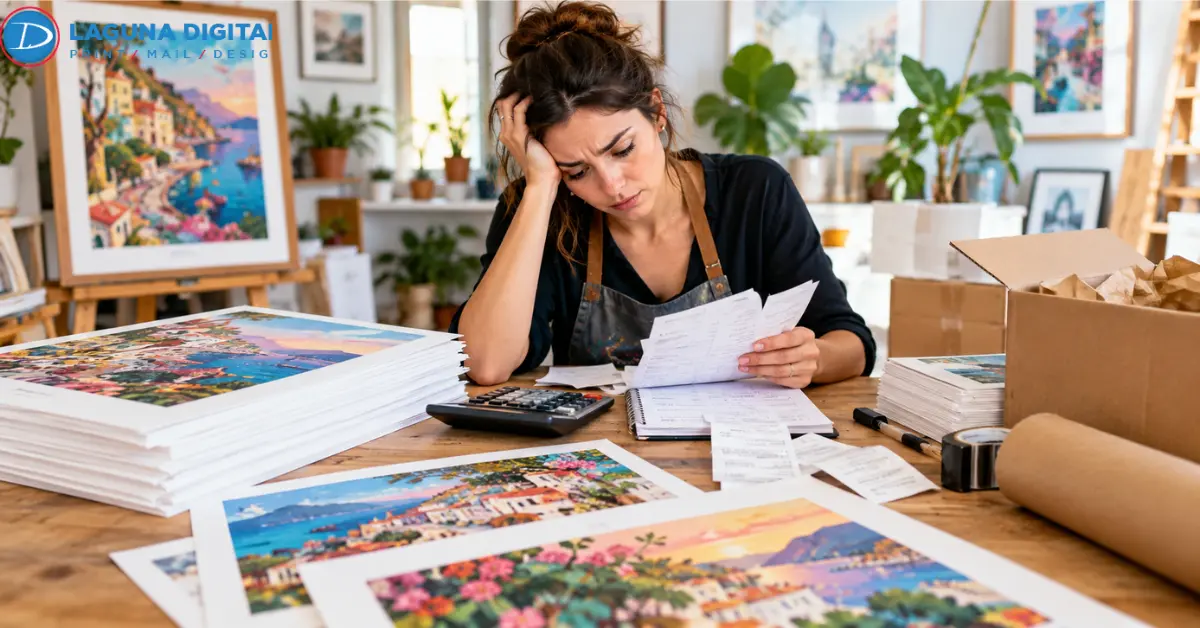
A first print edition can sell steadily and still leave the artist short of cash. The printer was paid weeks ago. Orders keep arriving, so the numbers seem healthy. Then the real costs show up one parcel at a time, starting with mailers and postage before the sales platform takes its fee. Add the evenings spent packing orders, and the profit that looked obvious can shrink to almost nothing.
Most of the trouble traces back to how the budget was built. Many artists treat the printer’s quote as the full cost, yet it only prices one stage. Selling art prints runs from the original artwork all the way to a parcel on the buyer’s doorstep.
For fine art prints reproduced from a painting, that journey includes capturing the image before production starts.
Print Edition Costs Beyond The Printer’s Quote
Setup And Capture
Start a worksheet for art print production costs before choosing a quantity. Artwork capture, color correction, sample prints, and product photography belong to it. These expenses arrive before the first customer pays.
An estimate for fine art scanning should explain the files supplied and the corrections included. A painter planning several print sizes needs to discuss those sizes before capture. Otherwise, a file suitable for the smallest version may need further work for a larger one.
The printing service should also distinguish image dimensions from sheet dimensions. Borders reduce the image area on a fixed sheet size. That matters when a buyer expects an artwork to fit an existing mat.
Packing And Selling Costs
Art print costs continue after production. Every order needs a backing board and a sleeve, and both go inside a rigid mailer. Someone also has to print the label and carry the parcel to the carrier, which takes time even when it costs nothing extra.
Pack one sample order before setting the delivery charge. Put the finished parcel on a scale and note its size, then check carrier rates for the regions where most buyers live. Larger packaging can change the economics of an otherwise modest size increase.
A $75 Print Edition Sale In Practice
The following example uses assumed U.S. direct-sale costs. It is a planning exercise, not a supplier quote or an industry price benchmark. Sales tax is excluded.
| Expense | Assumed Cost |
| Capture And Approved Proof | $150 Upfront |
| First Batch Of 25 Copies At $12 Each | $300 Upfront |
| Total Initial Spending | $450 |
| Packaging And Postage | $12 Per Sale |
| Fulfillment Labor | $5 Per Sale |
| Assumed Processing At 3% Plus $0.30 | $2.55 On A $75 Sale |
Print Edition Cash Recovery
A $75 sale leaves $55.45 after the listed packing, postage, labor, and processing expenses. Recovering the $450 takes nine sales, rounded up from 8.12. The printing charge already sits inside the initial spending. Subtracting it again would count the same payment twice.
After those nine sales, 16 copies remain. Their presence on a shelf does not make them available cash. Advertising, overhead, returns, and replacements still need consideration before calculating final profit.
Pricing For Direct Sales And Galleries
With the expenses visible, art print pricing becomes a decision that can be tested. Under the example’s assumptions, ten $75 sales would return $554.50 toward the $450 outlay. The remaining $104.50 must cover unlisted expenses before it becomes profit.
An art business needs this calculation for each sales channel. At a hypothetical 50% gallery commission, the artist receives $37.50 from a $75 sale. The direct-sale budget cannot simply be carried across.
A print edition price also needs a realistic audience. Compare work with similar dimensions, materials, and sales history. Published asking prices can provide context, but evidence of completed sales is more useful.
Print Edition Proofing And Paper Choices
The budget can absorb a planned proof more easily than a rejected batch. When assessing giclée printing services, use a physical sample of the actual artwork on the proposed production paper.
Paper choice is part of color management. Hahnemühle’s ICC Profile Guidance explains that an output profile describes a particular printer, ink, and paper combination. Changing one component deserves another look at the result. www.hahnemuehle.com
For a watercolor, examine pale washes and subtle changes in tone. For a darker image, inspect detail in the shadows. Check both under consistent lighting, with the original available for comparison.
The Approval Record
A useful approval record contains the final file, paper name, finished dimensions, border measurements, and accepted proof. It gives later batches a reference that a remembered screen image cannot provide.
Before capture, any painting with heavy texture or delicate surface detail calls for a conversation about fine art scanning requirements. Ask the printing service how it judges a copy to be defective as well. A clear rule for replacing prints that miss the agreed specifications prevents an awkward dispute later.
Smaller Batches And Stock Control
Announcing an edition of 50 is not the same as ordering 50 copies on day one. For limited edition prints, the cap describes the authorized total. The opening batch describes the stock being paid for now.
Take two assumed prices. Ten copies at $16 each come to $160, while fifty copies at $10 each total $500. The larger order does cut $6 from every copy, but it also ties up an extra $340 before a single print has sold. Before deciding, request a quote for both quantities so the comparison rests on real figures.
Bulk art print printing pays off only when the saving per copy outweighs the risk of boxes sitting unsold. Likes and comments feel encouraging. They are not orders, though, and a list of paid preorders is much stronger proof that a bigger run will move.
Edition Limits And Reorders
When selling art prints, keep a print edition register that tracks where each numbered copy went. Most will sell, and a few may leave as gifts. Others end up damaged or held back for a show. Rejected sheets need a column of their own, so they never make the stock count look bigger than it really is.
An art business can use fulfilled orders to replace guessed labor and postage with actual costs. That makes the next buying decision more reliable.
Frequently Asked Questions
How Much Should An Artist Charge For A First Print Edition?
Begin with the full cost of each copy and a cautious estimate of monthly sales. Together, those two numbers point to the lowest price that still works. Art print pricing has to go further, though, leaving room for profit at a level the target buyers will accept. The $75 figure above is a worked example of the method rather than a suggested retail price.
Which Expenses Are Most Often Missing From The Budget?
Art print production costs can include capture, corrections, proofs, and rejected sheets. Overall art print costs keep climbing after the press stops. Packing takes time and materials, while every sale carries a platform fee and postage. When a project involves plates or screens, keep traditional printmaking costs on a separate sheet so they stay out of the digital print budget.
Are Giclée Prints Worth The Extra Cost?
Giclée printing services usually charge more. That premium is easier to justify when buyers care about close color and fine detail on good paper. If a printer calls its fine art prints archival, ask which paper and inks support that claim. Compare fine art printing services on documented specifications.
How Many Copies Should The Opening Batch Contain?
Paid demand should set the number first. After that, look at how much cash can safely sit in stock, then check whether the supplier’s minimum order and turnaround fit the plan. Compare small-batch and bulk art print printing quotes using the cash committed if only five copies sell. A cheaper price per copy means little when most of the run stays in a drawer.
Can A Limited Edition Be Printed In Batches?
Yes. Limited edition prints are often produced in batches, as long as the printer can repeat the approved result on the same paper every time. Keep the declared cap fixed and record numbering. Disclose artist’s proofs separately, and confirm paper availability before relying on future orders.
Nutshell
A profitable print edition comes from a few choices that fit together. An honest budget lets the price carry the real costs. The approved proof then sets the standard for every copy, and the first batch stays small enough to match orders that buyers have actually paid for.
To start, send Laguna Digital the artwork size and the sheet size planned for the print. Mention a preferred paper and a rough starting quantity as well.
Ask for an itemized estimate and a physical proof, then weigh the full cash outlay against a cautious sales forecast before approving the first batch.