

The material of your cards makes an impression. Whether they are flimsy or sturdy, glossy or matte, you begin to create your brand. Thoughtful consideration should therefore be given to choosing your printed greeting cards.
For folded cards, choose 100- 110 lb cards. For flat cards, choose 120- 130 lb. To provide good ink absorption from a pen, choose uncoated or silk inner panels. Score all folds.
Choosing The Right Paper For Printed Greeting Cards
If your cards appear to droop, then it gives a cheap appearance. Opacity: Thin card can show through the front design if you have written in pen on the back. Surface Finish: Controls colour, reflective light, and smudging from pens.
A good balance between these factors should be chosen. Sympathy cards and product launch mailers would rarely be printed on the same material.
As Charles Eames, an American designer, once said, “The details are not the details. They make the design.” The choice of card used in your printed greeting cards contributes to this design. This is decided very early in production.
Understanding Cardstock Weight Before Placing An Order
No spec on a quote causes more confusion than weight.
Pound Ratings
In the USA, card weights are measured according to the weight of 500 sheets. Card cover weights are measured according to 20x26inch sheets. Printing paper (text weight) is measured using 25x38inch sheets. As text weight sheets are larger, a 100lb text weight card will be much thinner than a 100lb card cover. You should therefore always check that the quote specifies the cover card.
GSM And Caliper
GSM measurements reduce confusion. As the measurement is taken on the same area regardless of card type, it makes it easier to find the right card for printing greeting cards online. If you have a specification sheet, knowing the GSM value means you can find the right card. However, knowing how thick the card is in points can also help. 1 point = 1/1000 of an inch. Even cards of the same GSM measurement (either coated or uncoated) may have different thickness. If the tactile nature of the card is important to you, ask for both measurements.
Weight By Card Format
Folded cards get rigidity from the fold itself, and most printed greeting cards for business use sit in the 100 to 110 lb range. Flat cards have nothing to brace them, and below about 120 lb cover they start to feel like postcards. When choosing cardstock for cards that carry ribbon, foil, or a tipped-on photo, move up one step. That small cardstock weight increase keeps embellished pieces from sagging in the envelope.
| Cover Weight | Approximate GSM | Best Fit |
| 80 lb cover | 216 | Inserts and layered panels |
| 100 lb cover | 270 | Everyday folded cards |
| 110 lb cover | 298 | Premium folded cards |
| 130 lb cover | 352 | Flat cards and heavy add-ons |
Comparing Coated And Uncoated Paper Finishes
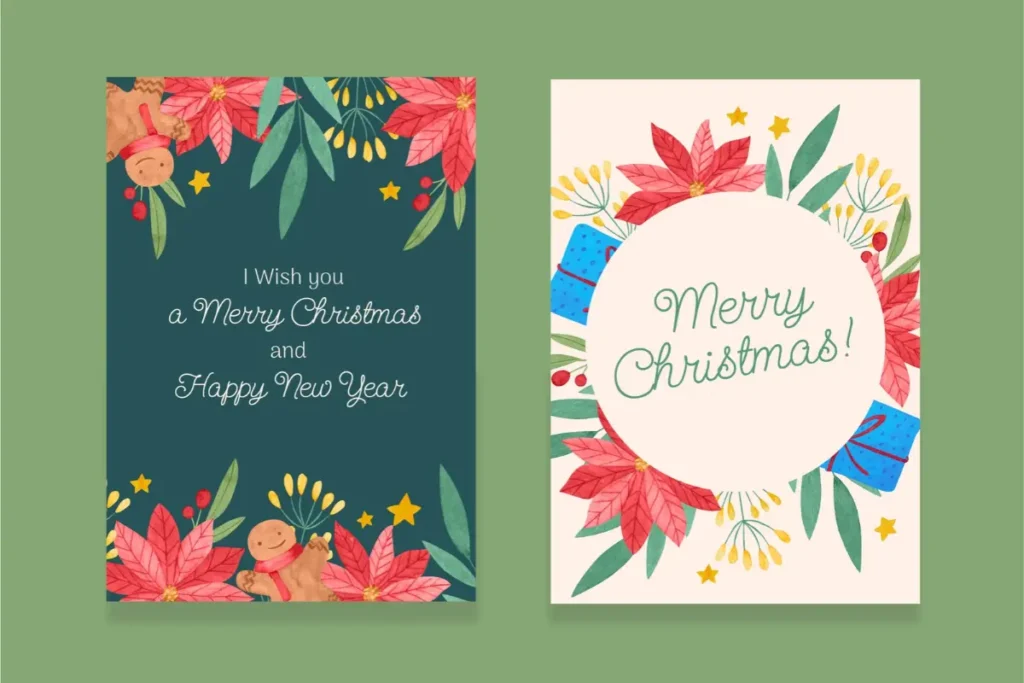
Once the weight has been decided, consideration should be given to paper type. Most options can be placed in one of the following groups:
Gloss Coating
Glossy paper gives bright colours and deep black. However, under office lighting, glossy paper can appear very shiny and smudgy with a ballpoint pen. Glossy is suitable for printing photo cards only (on the front) in cardstock printing.
Silk And Matte Coating
This is a good middle choice for many designers. Colours printed on silky cardstock paper are crisp, but there is less shine than glossy. This makes it easy to write with a pencil or ballpoint pen. It may take gel pens a little longer to dry.
Uncoated And Textured Stock
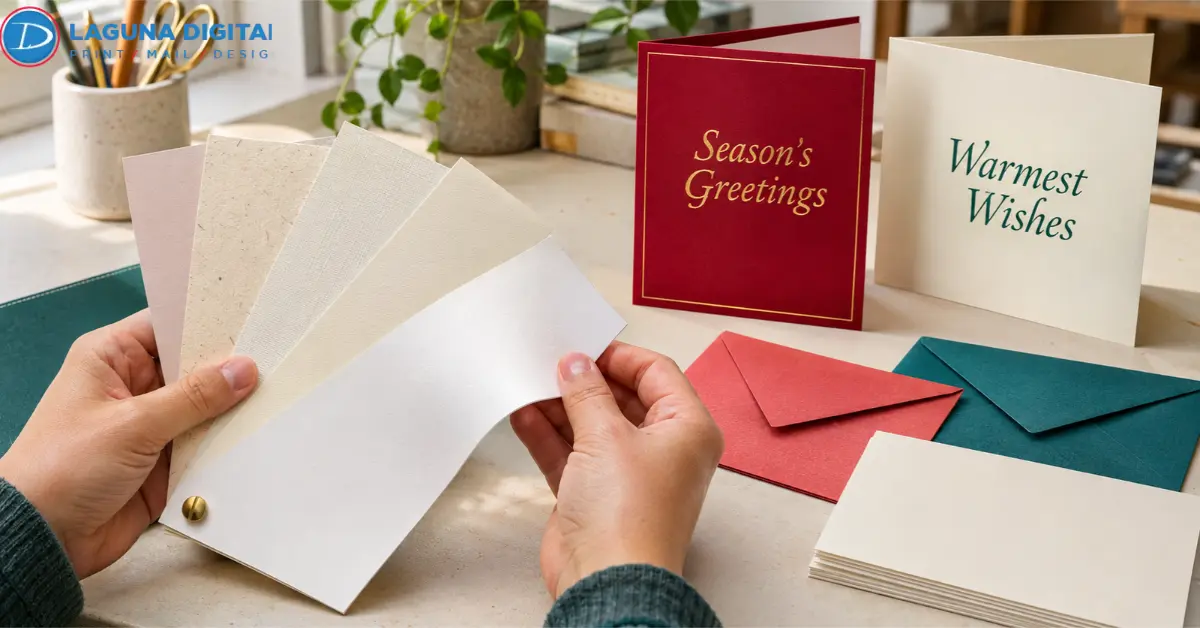
As ink will soak into the paper, colours will be more muted. If you have approved a brand colour on glossy paper, you may need to adjust it on uncoated paper. It is very easy to write on. The felt or flax textures give it a handmade appearance and would be suitable for thank you/sympathy cards.
However, if deep textures are used in digital greeting cards, large solid areas may become patchy. If there are large blocks of colour in the printed greeting cards, a smoother paper would be safer to choose.
Specialty Finishes
A soft touch finish will give a smooth velvet texture and will resist finger smudging. Foil works best on a matte or uncoated card in order to get the maximum contrast. With any additional finishes, extra processing time is required. Consider this in advance for any deadlines around festive periods.
Preventing Cracks And Smudges On Folded Cards
Common problems with printed cards occur on folds and panels. These can be avoided.
Scoring Before Folding
If you fold thick cards without scoring, breaks may occur. By scoring the correct crease into your cards, the fibres are forced to compress and reduce the chance of breakage. If you have dark ink on the vertical spine of your card, breaking is very visible. If you do get small breaks, they will appear as a light strip along the fold.
Grain Direction
Paper has fibres that run in one direction during production. If you fold in the direction of the grain, it will be smooth. However, if you fold across the grain, even with a scored line, then breaking may occur. When choosing card stock for print, consideration should be given to the grain. Ask for details of the grain before designing your printed greeting cards on the printing sheets.
Writable Inside Panels
By using a C1S card, signatures can be added easily. C1S means only one side of the card is coated, meaning that you can easily add signatures onto the uncoated inner panel. If many people need to sign your greeting cards, try testing with the exact pens on a finished card.
Pairing Each Card With The Right Envelope
If a card is too loose, it may cause problems in transit. If the card is too tight, it may tear the envelope. The following standard sizes avoid this issue.
- A2 Envelopes (4 3/8 x 5 3/4″) = 4.25 x 5.5 cards
- A6 Envelopes (4 3/4 x 6 1/2″) = 4.5 x 6.25 cards
- A7 Envelopes (5 1/4 x 7 1/4″) = 5 x 7 cards
Be careful with square envelopes. If a letter has a ratio smaller than 1.3, then under First Class Mail, this letter will incur a surcharge as it is not machinable. Weigh your cards with their envelopes and inserts in place before bulk printing.
Selecting Paper Based On The Purpose Of Each Card
Consider what occasion the cards will be used for.
- Thanks to clients: Use 110lb smooth/smooth textured card to allow writing.
- Christmas: Use silk on the front and uncoated on the back. This means you can print your graphics in full colour and sign them on the same card. See our guide to creating a branded Christmas card for layout ideas.
- Photo cards: Gloss or silk to make sure that faces/products are clear.
- Cards of sympathy: Felt card or soft uncoated card. Pale coloured inks.
- Cards for retail display: Use 110- 130 lb cards to withstand frequent handling.
As a guideline for bespoke greeting cards, choose from these pairings. A bakery may want to match their card stock to the colour of their pastries, using kraft coloured uncoated paper. Alternatively, a law firm may want to keep their bright white silk card.
Both are appropriate for their target audience. For retail sale cards, durability is more important than feel. Find out the sizes and card stock options available for each pairing on the Greeting Cards.
Checking A Proof Before The Full Print Run
Checking your proof for a short time will help prevent any issues with the paper in your printed cards.
- Feel the card. You can not feel the texture and thickness of the card on screen.
- Fold the card. Check if there are any creases/splits in the fold.
- Sign. Sign with the pens that will be used by your team.
- Check colours. Ensure the colours match the approved file.
- Print extra. Mistakes may occur in signing.
It is very important to review proof of the cards if you are ordering online. If you are ordering from a local Greeting Card Printer, you can get a folded sample to check before approving your print. If the colours have changed on an uncoated card, we can adjust the file for you to make sure the colours match. We can do this for a fraction of the cost of reprinting.
Frequently Asked Questions
What Is The Best Paper Weight For Greeting Cards?
Folded cards work best on 100 to 110 lb cover, roughly 270 to 298 gsm. Flat cards need 120 to 130 lb cover to feel substantial.
Is Matte Or Glossy Paper Better For A Card?
Matte or silk suits most printed greeting cards because it reduces glare and accepts handwriting. Gloss fits photo-heavy fronts.
What Is The Difference Between Cardstock And Printing Paper?
Office copy paper is usually 20 to 24 lb bond, about 75 to 90 gsm. Cardstock paper starts near 65 lb cover, or 176 gsm, and stands up when folded.
What Size Envelope Fits A 5×7 Card?
An A7 envelope, 5 1/4 by 7 1/4 inches, fits a 5 x 7 card with comfortable clearance. Printing the envelopes on a matching stock keeps the set consistent.
Do Heavier Cards Cost More To Mail?
A folded 5 x 7 card on 110 lb cover usually stays under one ounce in a standard envelope. Square envelopes, rigid inserts, or bulky add-ons can push postage higher, so weigh a sample before any bulk greeting card printing order ships.
Wrapping It Up
Choosing the right weight paper, finish, folding, and envelope for greeting cards can take a few minutes to get right. This will decide if they sit nicely on a desk, or end up in a skip!
With physical samples, creased folds and proofing at Laguna Digital, you can be confident you get the perfect cards. Just submit a size, quantity, artwork, and we’ll create high quality printed cards for you to match the thought put into your message.